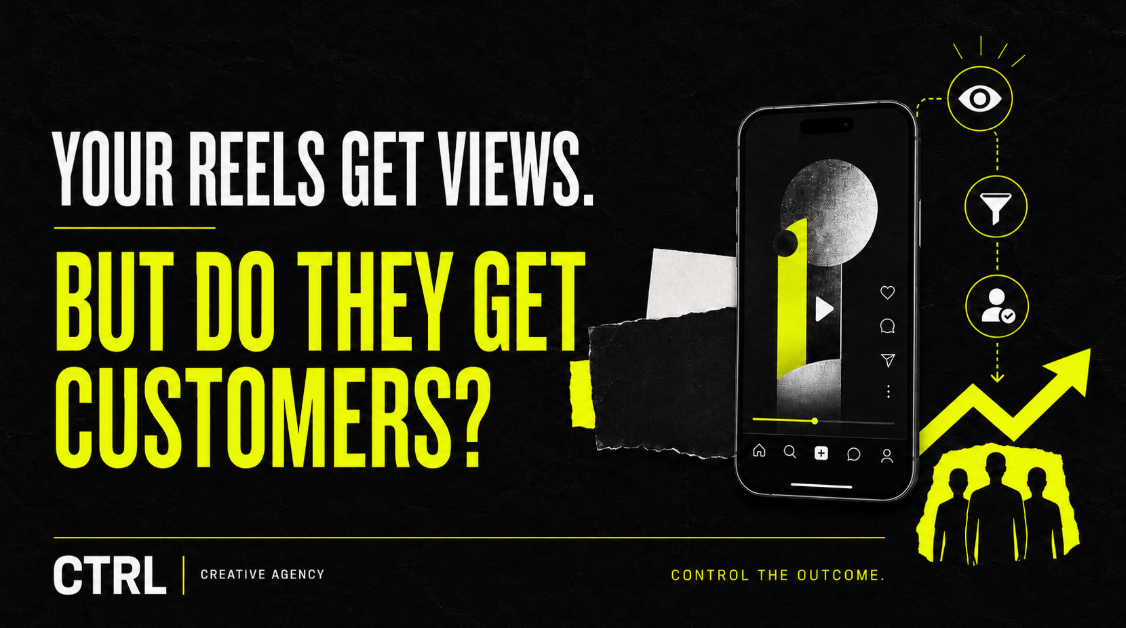

Businesses have been told that Reels are essential for growth. So they follow trends, point at text, use popular audio, post behind-the-scenes clips, and celebrate when a video reaches thousands of views.
Then they check the results.
No inquiries. No appointments. No qualified leads. No noticeable change in revenue.
Here is the uncomfortable truth:
A Reel can perform well and still do absolutely nothing for your business.
Views are attention. Attention can help, but attention is not automatically trust—and trust is not automatically a sale.
If your Reels are reaching people but not creating customers, the problem is not necessarily the algorithm. The content may be doing exactly what you designed it to do: entertain strangers without giving the right customer a reason to act.
The goal is not simply to make more Reels. The goal is to create videos that attract the right audience, communicate real value, build trust, and lead people toward a clear next step.
Stop Treating Views Like Revenue
One viral Reel can introduce your business to thousands of people. That exposure may be valuable—but only when the audience and message connect to what you actually sell.
A contractor does not need 100,000 random viewers who enjoy demolition videos. The contractor needs property owners, developers, facility managers, and decision-makers who understand the quality of the work and have a reason to start a conversation.
A restaurant does not only need people to admire a beautiful plate. It needs nearby customers to understand the experience, know when to visit, and feel compelled to make a reservation.
A chiropractor, med spa, realtor, consultant, or service provider does not need empty reach. Each needs the right person to think:
“This business understands my problem. I trust them. I know what to do next.”
That is the difference between content that gets watched and content that helps generate business.
What Makes a Reel Convert?
A conversion-focused Reel usually does four things:
- It earns attention from a specific person.
- It addresses something that person already wants, needs, fears, or questions.
- It gives the viewer a reason to trust the business.
- It provides a relevant next step.
This does not mean every video should feel like an advertisement. In fact, the strongest business content often feels educational, useful, honest, or entertaining first.
But there should still be a strategic connection between the video and the business behind it.
1. Start With the Customer, Not the Trend
Before filming, ask one question:
Who is this video for?
“Everyone” is not a useful answer.
The more clearly you understand the intended viewer, the easier it becomes to write a hook that stops the right person.
A strong Reel does not need to appeal to the entire internet. It needs to feel immediately relevant to the people most likely to need your business.
Compare these hooks:
“Come to work with me today.”
Versus:
“What commercial property owners should document before construction begins.”
Or:
“Watch us make this drink.”
Versus:
“Kansas City finally has a handcrafted cocktail experience without the alcohol.”
Or:
“Three marketing tips for businesses.”
Versus:
“If your business is posting consistently but still getting no inquiries, check these three things.”
The second version of each hook gives a specific viewer a reason to keep watching.
Trends can support the delivery, but they should never replace the strategy.
2. Make the First Seconds Earn the Rest
Your opening should create immediate relevance, tension, curiosity, or recognition.
Avoid slow introductions, lengthy logo animations, and several seconds of footage before the viewer understands the point.
People do not owe your content their attention. Your Reel has to earn it.
Strong business hooks often fall into a few categories:
Call Out the Problem
- “Your website may be costing you leads before anyone ever calls.”
- “If your restaurant is busy on weekends but empty during lunch, this may be why.”
- “Most contractors are documenting completed projects too late.”
Challenge an Assumption
- “Posting more often will not fix unclear marketing.”
- “Going viral may be the least valuable thing your business does this month.”
- “Word of mouth is powerful—but depending on it alone is not a growth strategy.”
Promise a Useful Outcome
- “Here is how to turn one content day into a month of marketing.”
- “Three videos every realtor should record at a new listing.”
- “What to show online before asking someone to book an appointment.”
Open a Story
- “This business had great work, strong referrals, and almost no digital presence.”
- “We did not need to reinvent the brand. We needed to make people understand it.”
- “This event sponsorship looked impressive—but it had no plan to generate a return.”
The hook should not trick the viewer. It should make a clear promise that the rest of the video fulfills.
3. Build Reels Around Buying Questions
Some of your best content ideas are already sitting in your inbox, reviews, consultations, sales calls, and customer conversations.
Write down the questions people ask before buying:
- How much does it cost?
- How long does it take?
- What happens during the process?
- What makes your approach different?
- Is this service right for me?
- What should I do before getting started?
- What mistakes should I avoid?
- What result can I reasonably expect?
Each question can become a Reel.
This content works because it meets potential customers during the decision-making process. It reduces uncertainty, demonstrates expertise, and allows the business to answer an objection before the viewer ever reaches out.
Useful content does not give away too much. It gives people enough clarity to recognize that they need the right professional.
4. Show Proof Instead of Making Claims
“We provide high-quality service” is a claim nearly every business makes.
Proof is more persuasive.
Use Reels to show:
- Before-and-after results
- Completed projects
- Customer testimonials
- Your process in action
- The details most people overlook
- A problem you identified and solved
- The experience of working with your business
- A measurable client outcome
Instead of saying your team is thorough, show the inspection process.
Instead of saying your restaurant provides an elevated experience, show the room, service, music, presentation, and customer reactions.
Instead of saying your agency creates strategy, explain the decision behind a campaign.
People trust what they can see and understand.
5. Give Every Reel One Job
Trying to educate, introduce the company, explain five services, tell a story, and make an offer in 30 seconds usually creates a confusing video.
Give each Reel one primary job:
- Reach: Introduce the brand to the right audience.
- Educate: Answer a question or explain a problem.
- Build trust: Show the people, process, values, or expertise behind the business.
- Prove: Demonstrate results or the customer experience.
- Convert: Encourage a specific action.
Not every Reel should ask for a sale.
Some should create recognition. Some should make the viewer save or share the information. Some should address objections. Others should make a direct offer.
Together, those videos create a path from discovery to decision.
6. Use a Call to Action That Matches the Video
“Follow for more” is not the only call to action—and it is often not the most useful one.
The next step should make sense for the content and the customer’s level of readiness.
Examples include:
- “Save this before planning your next content day.”
- “Send this to the person managing your company’s marketing.”
- “Comment ‘AUDIT’ and we’ll tell you where your online presence is losing attention.”
- “View the full project in our portfolio.”
- “Reserve your table through the link in our bio.”
- “Request a quote for your next commercial project.”
- “Message us if you want to build this system for your business.”
One Reel should have one clear next step.
If the viewer has to decide between following, commenting, messaging, visiting your website, calling, downloading something, and buying, they may do none of them.
7. Make the Profile Ready for the Attention
A Reel does not convert by itself. It sends people somewhere.
Before focusing on reach, make sure your profile quickly answers these questions:
- What does this business do?
- Who does it serve?
- Where is it located, or does it work nationwide?
- Why should someone trust it?
- What should the visitor do next?
Your bio, pinned content, highlights, portfolio, reviews, link, and recent posts should continue the story the Reel started.
If a strong video brings someone to a confusing profile, the attention is wasted.
The content and the destination must work together.
8. Film for the Platform Without Losing the Brand
Instagram Reels are built for a full-screen mobile experience. That means your videos should feel native to the platform without losing the identity of your business.
For the strongest viewing experience:
- Film vertically in a 9:16 format.
- Use clear audio and readable captions.
- Keep important text away from interface elements.
- Use movement, framing, or visual change to support the opening.
- Remove pauses and anything that delays the point.
- Choose a cover that clearly communicates the topic.
- Maintain recognizable brand language, colors, perspective, or production style.
Good production helps people stay.
Clear strategy gives them a reason to care.
A Simple Reel Formula for Businesses
Use this structure when you need a repeatable starting point:
Hook
Identify the person, problem, or desired result.
Value
Give the answer, show the process, or tell the relevant story.
Proof
Demonstrate why the viewer should believe you.
Next Step
Tell the viewer what to do if the content was relevant.
For example:
Hook: “Contractors: if you only photograph the finished project, you are missing some of your strongest marketing content.”
Value: Explain the importance of documenting progress, workmanship, problem-solving, and transformation.
Proof: Show clips from multiple stages of a real project.
Next step: “If you need professional construction documentation for your next project, view our Build Control services.”
The video is useful, specific, credible, and connected to a service.
What Should You Measure?
Views tell you how many times content was watched or played. They do not tell you the entire business outcome.
Track the signals that match the Reel’s purpose:
- Watch time and retention
- Shares and saves
- Profile visits
- Website clicks
- Comments from potential customers
- Direct messages
- Calls and contact-form submissions
- Appointment requests
- Quotes requested
- Reservations or purchases
- Qualified leads connected to the content
A Reel with 3,000 views and five qualified inquiries may be more valuable than one with 100,000 views and no meaningful action.
Virality is not the business model. Conversion is.
Reels Should Be Part of a System
Strong short-form video can create awareness quickly, but sustainable growth rarely comes from one platform or one piece of content.
The best-performing businesses connect Reels to a larger system that may include:
- A clear brand and offer
- A credible website
- Search engine optimization
- Google Business Profile visibility
- Professional photography and video
- Email and SMS follow-up
- Reviews and case studies
- Paid promotion
- Community partnerships
- A consistent sales process
Social media can open the door. The rest of your marketing has to help the customer walk through it.
Create Reels With a Business Outcome in Mind
You do not need to dance, chase every trend, or turn your company into a full-time entertainment channel.
You need to understand your customer well enough to create content that matters to them.
The next time you plan a Reel, do not begin by asking:
“What is trending?”
Ask:
- Who needs to see this?
- What should they understand after watching?
- Why should they trust us?
- What should they do next?
That is how a Reel becomes more than content.
It becomes part of the customer journey.
Turn Your Content Into a Growth System
CTRL Creative Agency helps businesses create content with direction.
We combine brand strategy, photography, videography, Reels, social media management, websites, SEO, paid campaigns, email and SMS marketing, community partnerships, and performance-driven creative to move audiences from attention to action.
If your business is getting views but not customers—or struggling to create consistent content at all—it may be time to stop feeding the algorithm and start building a strategy.
Start the conversation at CTRL Creative Agency or email hello@ctrlcreative.org.
Control The Outcome.
Leave a Reply