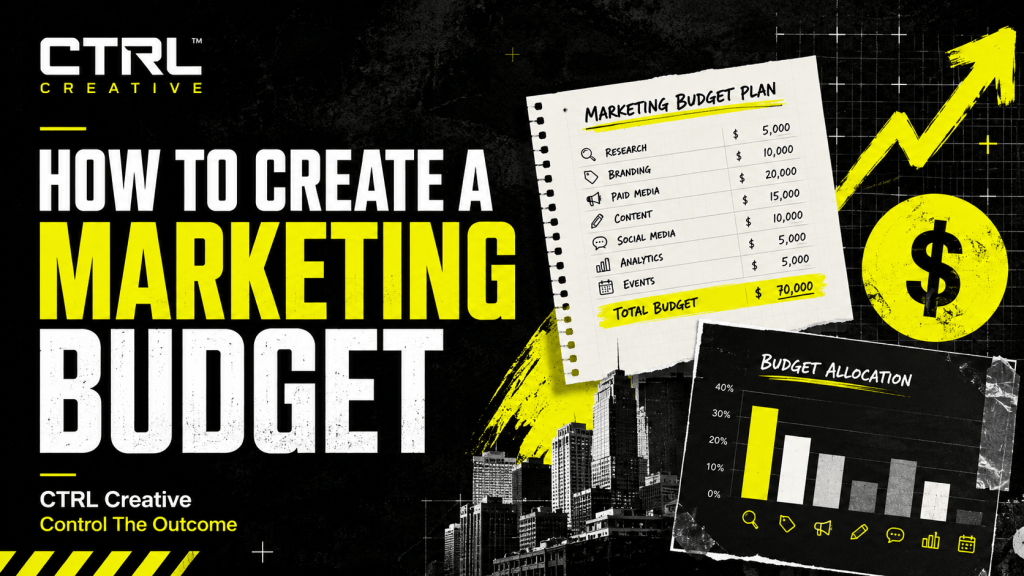
Marketing shouldn’t feel like throwing money at Instagram ads, content creation, websites, and random promotions hoping something eventually works.
A strong marketing budget gives every dollar a purpose.
Whether you’re launching a new business, trying to increase sales, or ready to scale an established brand, understanding how to create a marketing budget can help you make smarter decisions, track your return on investment, and stop wasting money on marketing that isn’t moving your business forward.
What Is a Marketing Budget?
A marketing budget is the amount of money your business intentionally sets aside for activities designed to attract, convert, and retain customers.
Your marketing budget may include:
- Social media marketing
- Content creation
- Photography and videography
- Paid advertising
- Website development
- Search engine optimization (SEO)
- Email marketing
- Branding and graphic design
- Influencer marketing
- Public relations
- Events and sponsorships
- Marketing software
- Print materials
- Marketing consultants or agencies
The important part is that your marketing budget shouldn’t simply be a list of expenses.
It should connect directly to your business goals.
Step 1: Start With Your Revenue
Before deciding how much to spend on marketing, determine what your business currently generates—or what you realistically expect it to generate.
Businesses often set their marketing budget as a percentage of revenue.
There isn’t one perfect percentage for every company. Your marketing investment will depend on your industry, growth goals, profit margins, competition, and how established your business already is.
For example, a newer company trying to build awareness may need to invest more aggressively than an established company with strong brand recognition and repeat customers.
Instead of asking:
“What is the cheapest marketing I can get?”
Ask:
“What amount can I strategically invest to reach the next level of revenue?”
That shift alone changes how you approach marketing.
Step 2: Define Your Marketing Goals
Your budget should follow your goals—not the other way around.
Before spending anything, decide what marketing needs to accomplish.
Your goal may be to:
- Generate more leads
- Increase website traffic
- Book more appointments
- Increase restaurant traffic
- Build brand awareness
- Sell more products
- Grow an email list
- Increase social media engagement
- Enter a new market
- Launch a new service
- Improve customer retention
- Position yourself as an industry expert
Make your goals measurable whenever possible.
Instead of saying:
“I want more customers.”
Try:
“I want to generate 25 qualified leads per month.”
Now you have something you can build a strategy—and a budget—around.
Step 3: Understand Your Customer Acquisition Cost
One of the most important numbers in your marketing strategy is your customer acquisition cost, commonly called CAC.
This tells you approximately how much it costs to acquire one new customer.
For example:
If you spend $1,000 on marketing and gain 10 new customers, your customer acquisition cost is approximately $100.
That number becomes even more valuable when you compare it to your customer value.
If the average new customer brings your business $1,500, spending $100 to acquire that customer could be a strong investment.
But if you’re spending $300 to acquire a customer who only generates $100 in profit, something needs to change.
Marketing should ultimately support profitable growth.
Step 4: Separate Your Marketing Into Categories
Instead of putting everything into one large “marketing” bucket, break your budget into categories.
Brand Development
This includes your logo, visual identity, messaging, brand strategy, photography, and overall positioning.
Content Marketing
This may include social media videos, photography, blogs, graphics, short-form video, and educational content.
Digital Marketing
This includes SEO, email campaigns, website improvements, social media management, and online advertising.
Paid Advertising
This may include Google Ads, Meta Ads, TikTok Ads, sponsored content, or paid influencer partnerships.
Local Marketing
For local businesses, this could include community sponsorships, events, partnerships, print materials, networking, and local influencer campaigns.
Marketing Tools
Your business may also need software for email marketing, scheduling, CRM systems, analytics, social media management, or design.
Breaking expenses into categories makes it much easier to identify where your money is actually going.
Step 5: Prioritize Strategy Before Spending
One of the biggest marketing mistakes businesses make is paying for tactics before developing a strategy.
A business might spend money on:
- A new website
- Professional photography
- Facebook ads
- Reels
- Flyers
- Influencers
…but still struggle to generate results.
Why?
Because those are marketing tools.
They are not a marketing strategy by themselves.
Before investing heavily, you should understand:
- Who your target audience is
- What problem you solve
- Why customers should choose you
- Where your audience spends their time
- What content gets their attention
- What converts that attention into revenue
When those pieces are clear, your marketing budget becomes dramatically more effective.
Step 6: Budget for Consistency
Marketing usually works better when it is consistent.
Posting ten times during one week and disappearing for two months rarely builds lasting momentum.
Neither does running ads for a few days and deciding they “didn’t work.”
Your budget should allow your business to maintain a consistent presence.
That might mean allocating money monthly toward:
- Social media management
- Content production
- Advertising
- SEO
- Email marketing
- Photography or video
- Campaign development
A sustainable $1,500 monthly marketing strategy can often be more effective than spending $10,000 randomly throughout the year with no consistent plan.
Step 7: Leave Room for Testing
Not every marketing campaign will work perfectly the first time.
And that’s okay.
Strong marketers test.
You may test:
- Different video hooks
- Ad creatives
- Calls to action
- Landing pages
- Offers
- Email subject lines
- Social platforms
- Audience targeting
- Promotional campaigns
Set aside a portion of your marketing budget specifically for experimentation.
The goal isn’t to guess correctly every time.
The goal is to identify what works—and invest more heavily in it.
Step 8: Track Your Return on Investment
You cannot improve what you aren’t measuring.
Review your marketing performance regularly.
Track metrics such as:
- Leads generated
- Cost per lead
- Website traffic
- Conversion rate
- Sales
- Bookings
- Revenue generated
- Customer acquisition cost
- Social media reach
- Email subscribers
- Repeat customers
But remember: not every marketing metric is equally valuable.
A Reel receiving 100,000 views may look impressive, but if it generates zero leads, bookings, or brand opportunities, those views may not matter to your bottom line.
Marketing should create attention with intention.
How Much Should a Small Business Spend on Marketing?
There is no universal marketing budget that works for every small business.
A local restaurant has different marketing needs than a construction company.
A startup launching into a competitive market will have different needs than a company that has operated successfully for twenty years.
Your budget should consider:
Revenue: What can your company realistically invest?
Growth goals: Are you maintaining your current business or aggressively trying to grow?
Competition: How difficult is it to get attention in your market?
Customer value: How much revenue does an average customer generate?
Current visibility: Are people already familiar with your company?
Internal resources: Can your team create and manage marketing internally, or will you need outside support?
The right marketing budget is the one that supports your goals without putting your company into an unsustainable financial position.
Example Small Business Marketing Budget
Imagine a business has a $3,000 monthly marketing budget.
Instead of randomly spending it, the company might divide it strategically:
- $1,000 — Content creation and video marketing
- $750 — Social media management
- $500 — Paid advertising
- $350 — SEO and website optimization
- $250 — Email marketing and software
- $150 — Testing and miscellaneous campaigns
Another company may allocate those funds completely differently.
That is exactly why a customized marketing strategy matters.
Your marketing budget should reflect how your specific customers discover and choose businesses like yours.
Marketing Is an Investment—When There Is a Strategy Behind It
The goal isn’t simply to spend more money on marketing.
The goal is to make smarter marketing investments.
A successful marketing budget gives your business the ability to consistently build awareness, generate leads, nurture customers, test new opportunities, and measure what is actually creating revenue.
If your marketing currently feels scattered, inconsistent, or impossible to measure, the issue may not be that you need more marketing.
You may simply need a stronger strategy behind your budget.
At CTRL Creative, we help businesses take control of their marketing strategy, content, branding, and growth so they can stop guessing where their marketing dollars should go.
Because your brand shouldn’t just look good.
It should have a strategy designed to move your business forward.
Control the outcome.
Visit www.ctrlcreative.org to learn more about marketing strategy, branding, content creation, and growth services.
Leave a Reply