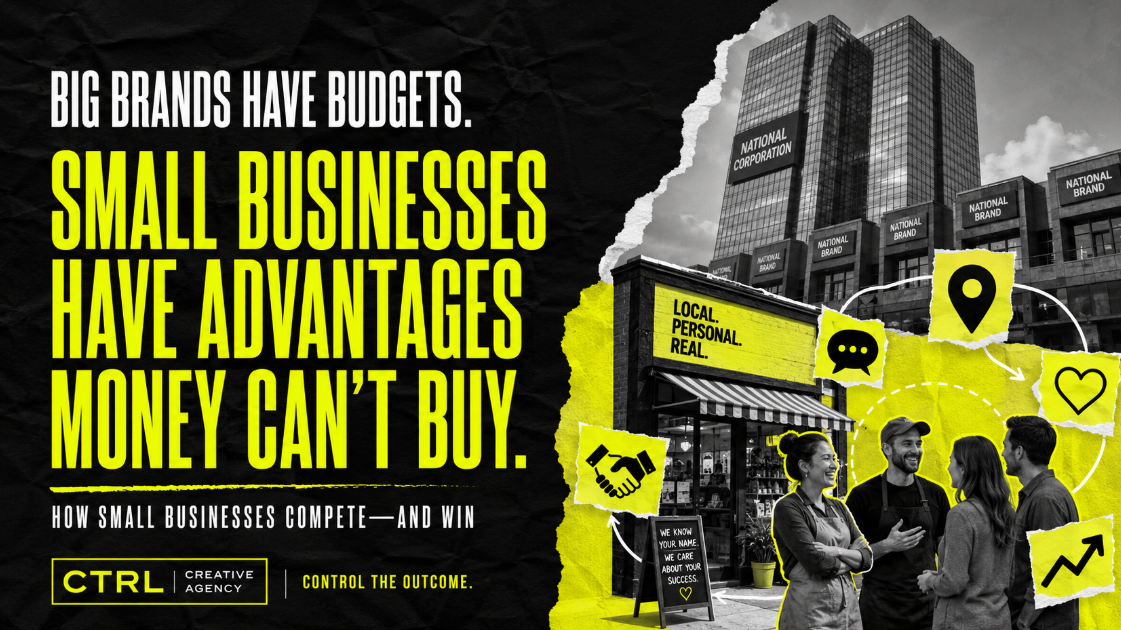

Small businesses are often told they cannot compete with national brands because they do not have the same budgets, teams, technology, locations, or name recognition.
That is only true if they try to compete the same way.
A local restaurant cannot outspend a national chain.
An independent contractor cannot run more advertisements than a nationwide construction company.
A small agency cannot employ hundreds of specialists.
A neighborhood wellness business cannot open a location in every major city.
But small businesses have advantages that large brands spend millions trying to imitate:
Personality. Proximity. Speed. Relationships. Flexibility. Trust.
A small business does not need to become a smaller version of a corporation.
It needs to become the clearest, most trusted, most relevant choice for the customers it is built to serve.
National Brands Have Scale. Small Businesses Have Access.
Large companies are designed for consistency and scale.
They need systems that can be repeated across hundreds of employees, departments, territories, franchises, or locations. That scale can create convenience, awareness, and operational power.
But it can also create distance.
Customers may interact with a national brand without ever knowing who owns it, who makes the decisions, or who will respond when something goes wrong.
Small businesses have direct access to their customers.
Owners can:
- Speak to customers personally
- Respond to feedback quickly
- Adjust offers without months of approval
- Build genuine local relationships
- Share real stories from the company
- Create personalized experiences
- Support specific community needs
- Make customers feel recognized
That is not a disadvantage.
That is a competitive advantage—when the business knows how to communicate it.
Stop Trying to Look Bigger Than You Are
There is a difference between looking professional and pretending to be a corporation.
Professionalism creates trust.
Pretending often removes the personality that makes a small business valuable.
You do not need vague corporate language, generic stock photography, complicated industry jargon, or a website that makes the company sound like it has 500 employees.
You need a clear presentation that shows:
- What you do
- Who you serve
- Why you care
- What makes your approach different
- What customers can expect
- Why people trust you
- How to take the next step
Small does not mean inexperienced, unprofessional, or incapable.
It can mean specialized, focused, responsive, flexible, and deeply invested in the outcome.
Own that position.
1. Compete With Specificity
National brands often need broad messages that work across different markets.
Small businesses can speak directly to a specific customer, industry, city, or problem.
Compare:
“Quality construction services for every project.”
With:
“Commercial renovations for restaurants, medical offices, salons, and retail spaces across the Kansas City metro.”
Or:
“Marketing solutions for growing businesses.”
With:
“Brand strategy, content production, and digital marketing for contractors, developers, hospitality brands, and community-driven businesses.”
The more specific your message becomes, the easier it is for the right customer to recognize that your business is relevant.
Specificity helps answer:
- Is this service for me?
- Does this company understand my industry?
- Have they handled this problem before?
- Do they work in my area?
- Can they deliver the outcome I need?
A national competitor may be known by more people.
Your small business can be more relevant to the person making the decision.
2. Compete With a Better Customer Experience
A large marketing budget cannot fully compensate for a frustrating customer experience.
Customers remember:
- How quickly you responded
- Whether you listened
- Whether the process was explained clearly
- Whether expectations were met
- Whether problems were handled honestly
- Whether they felt valued
- Whether the final result matched the promise
The U.S. Small Business Administration identifies excellent customer experience as one possible source of competitive advantage, along with factors such as product quality and pricing. The SBA’s marketing guidance encourages businesses to identify what specifically gives them an advantage over competitors.
A small business can often make decisions faster and personalize the experience more easily than a national company.
Use that ability deliberately.
Create:
- Faster response standards
- Clear onboarding
- Personal follow-up
- Transparent pricing or proposal explanations
- Consistent project updates
- Thoughtful post-purchase communication
- Easy ways to provide feedback
- A process for resolving problems
Customer experience is not separate from marketing.
It becomes the story customers tell about your business.
3. Make the Owner and Team Visible
People connect with people before they connect with companies.
Large brands often pay creators, spokespersons, and influencers to humanize the business.
Small businesses already have real people with real stories.
Show them.
Introduce:
- The owner
- Team members
- Partners
- Vendors
- Customers
- Community collaborators
- The people completing the work
Share why the business was started, what the team believes, how decisions are made, and what the work means to the people behind it.
This does not mean every owner must become an influencer.
It means customers should be able to understand who they are trusting.
Visibility creates familiarity. Familiarity can reduce uncertainty. Over time, that familiarity helps create preference.
4. Tell Stories a Corporation Cannot Copy
National brands can copy an offer.
They can copy a format.
They can copy a trend.
They cannot copy your history, relationships, customers, perspective, community, or lived experience.
Your story may include:
- Why you started the business
- A challenge you overcame
- The first customer who believed in you
- A project that changed the company
- A mistake that improved your process
- A community that supported your growth
- A customer outcome you are proud of
- The values behind a difficult decision
- The reason you continue doing the work
Storytelling gives people context.
It turns a business from a list of services into something customers can understand and remember.
Do not manufacture a dramatic story because marketing experts told you to have one.
Document what is already true.
5. Become Known for Something Specific
Small businesses often weaken their positioning because they are afraid of excluding potential customers.
They say they can help everyone with everything.
The result is a business no one knows how to describe.
You do not necessarily have to stop offering multiple services. But you should identify the problem, outcome, industry, or perspective you want to own.
A contractor may become known for:
- Commercial restaurant buildouts
- Medical office renovations
- Water-damage restoration
- Construction documentation
- Historic property renovations
A restaurant may become known for:
- An exceptional alcohol-free experience
- Live jazz and culinary dining
- A signature dish
- Late-night dining
- Community-centered events
A creative agency may become known for:
- Construction and development marketing
- Strategic content systems
- Experiential campaigns
- Community-driven growth
- Turning scattered marketing into a unified system
Being known for something makes referrals easier.
People cannot confidently recommend a business they cannot clearly explain.
6. Use Professional Content to Close the Perception Gap
Sometimes a small business delivers excellent work but looks less capable online than it actually is.
Outdated websites, inconsistent graphics, poor photography, unfinished profiles, and irregular content can create a perception gap.
The quality of the presentation does not match the quality of the business.
Professional content helps correct that.
Invest in:
- Strong brand positioning
- Professional photography
- Short-form video
- Case studies
- Customer testimonials
- Project documentation
- A credible website
- Clear service pages
- Consistent social media
- Professional proposals and sales materials
Customers cannot evaluate work they cannot see.
Document the process, not only the final product. Show the details, decisions, people, problem-solving, and care behind the outcome.
Your business may not have the largest campaign.
It can have the most credible proof.
7. Win Locally Before Trying to Reach Everyone
National awareness is not always the goal.
A small business may only need to become highly visible within a particular region, industry, or customer community.
Local visibility can come from:
- Google Business Profile
- Local SEO
- Customer reviews
- Community partnerships
- Networking groups
- Neighborhood platforms
- Local media
- Events
- Sponsorships
- Referral partners
- Business associations
- Collaborations with other local brands
The goal is to build enough relevance that customers repeatedly encounter the business in trusted places.
A small business can become dominant within its market without being known nationwide.
Depth can be more valuable than broad, disconnected reach.
8. Turn Community Involvement Into Real Relationships
Community marketing is not placing a logo on a flyer and calling it a partnership.
It involves participation.
Small businesses can:
- Host useful events
- Collaborate with complementary companies
- Support nonprofit initiatives
- Feature local creators
- Sponsor community programs
- Share other businesses’ work
- Create educational experiences
- Build referral relationships
- Participate in neighborhood conversations
- Introduce customers to helpful resources
The strongest community relationships are not purely transactional.
They are built through repeated support and shared value.
National brands may sponsor a community.
Small businesses can become part of it.
9. Move Faster
A large organization may need multiple approvals to respond to a trend, change an offer, launch a partnership, or adjust a campaign.
Small businesses can often act quickly.
That speed allows you to:
- Respond to customer feedback
- Create timely content
- Test new offers
- Build partnerships
- Adjust pricing or packaging
- Address market changes
- Launch small campaigns
- Personalize communication
- Correct problems before they grow
Speed should not mean reacting to everything without a strategy.
It means using your flexibility to make informed decisions faster than a larger competitor can.
10. Create Content From Real Expertise
Large companies can produce high volumes of polished content.
Small businesses can produce content with direct experience and specific insight.
A contractor can explain what actually happens during a commercial renovation.
A chiropractor can answer the questions patients ask before their first appointment.
A restaurant owner can explain the intention behind a menu.
A nonprofit leader can show how donations are used.
A realtor can break down conditions in a specific neighborhood.
A consultant can share lessons from real client work.
Google continues to emphasize helpful, reliable, people-first content and recommends creating unique, expert-led material instead of generic information that could have come from anyone. Google’s current guidance for search and AI experiences reinforces the value of original experience and non-commodity content.
Do not create content merely to fill a calendar.
Create content only your business could make.
11. Build a Strong Google Presence
A national brand may have enormous name recognition, but local searches can still create opportunities for nearby businesses.
Optimize your Google Business Profile with:
- Accurate information
- Relevant categories
- Services
- Current hours
- Professional photos
- Videos
- Regular updates
- Customer reviews
- Responses to feedback
- A strong website connection
Your website should also include:
- Service pages
- Location relevance
- Customer questions
- Case studies
- Helpful blogs
- Clear contact information
- Mobile-friendly design
- Internal links
Google cannot guarantee any business a particular ranking. Its SEO guidance instead recommends making websites easy to crawl and understand while creating reliable, useful content for people. Google’s SEO Starter Guide provides the foundational practices.
Search visibility allows a smaller company to compete at the exact moment a customer needs help.
12. Make Reviews Part of the Strategy
A national brand has recognition.
A small business can build reassurance through specific customer experiences.
Strong reviews help potential customers understand:
- What service was provided
- How the company communicated
- What problem was solved
- What the experience felt like
- Whether expectations were met
- Why the customer would recommend the business
Ask customers for honest feedback at the right moment—after a successful project, purchase, appointment, or event.
Respond thoughtfully to reviews instead of leaving them untouched.
When criticism appears, address it professionally. A calm, responsible response can demonstrate more credibility than a perfect rating with no personality.
13. Follow Up Better Than the Competition
Many businesses focus entirely on attracting new customers while ignoring the people who already know them.
Follow-up can include:
- Thank-you messages
- Review requests
- Maintenance reminders
- Rebooking campaigns
- Project anniversary check-ins
- Email newsletters
- Customer-only offers
- Referral invitations
- Event announcements
- Helpful educational content
Email and SMS allow small businesses to maintain direct relationships without depending entirely on social media algorithms.
A customer who has already had a positive experience is often more valuable than a stranger seeing the business for the first time.
14. Do Not Compete Only on Price
National brands may have the purchasing power, automation, or scale to lower prices.
Trying to win every customer by being cheaper can destroy a small business’s margins without creating loyalty.
Instead, compete through value:
- Expertise
- Specialization
- Responsiveness
- Customization
- Convenience
- Quality
- Experience
- Trust
- Service
- Access
- Community connection
- Better outcomes
Price matters, but it is only one part of the decision.
Your marketing should help customers understand what they receive, what risks are reduced, what experience is provided, and why the investment is worthwhile.
If the only visible difference between you and a competitor is price, customers will often choose the cheaper option.
Give them more meaningful reasons to choose.
15. Study Competitors Without Becoming Them
Competitive research is useful.
Copying is not.
The SBA recommends combining market research with competitive analysis to understand customers and identify what makes the business unique. Its competitive-analysis guide encourages businesses to examine demand, market size, location, saturation, pricing, and other factors affecting opportunity.
Study:
- How competitors position themselves
- Which audiences they target
- What customers praise
- What customers complain about
- Which services are emphasized
- Where the market appears underserved
- How the buying process works
- Which messages are repeated
- Where competitors are visible
- What they fail to explain
Then use those insights to sharpen your own position.
Do not copy another company’s voice, visuals, offers, or content. That only makes your business easier to compare and harder to remember.
16. Build Systems Before Growth Exposes the Gaps
Small businesses often want more customers before they have systems to manage them.
Growth can amplify:
- Slow response times
- Poor communication
- Inconsistent delivery
- Unclear responsibilities
- Weak onboarding
- Missing follow-up
- Customer-service problems
- Disorganized marketing
- Inaccurate information
Before increasing visibility, ensure the customer journey can handle the attention.
Map what happens when someone:
- Discovers the business
- Visits the website
- Sends an inquiry
- Receives a response
- Schedules a consultation
- Accepts an offer
- Becomes a customer
- Completes the experience
- Is asked for feedback
- Is invited to return or refer someone
Marketing creates demand.
Systems protect the experience.
Small Businesses Do Not Need to Win Everywhere
You do not need the most followers.
You do not need the largest advertising budget.
You do not need to appear on every platform.
You do not need to serve everyone.
You need to matter deeply to the right people.
That requires clarity about:
- Who you serve
- What you do best
- Why your approach matters
- Where your audience spends time
- What proof they need
- What experience you promise
- How you will consistently deliver it
National brands win through scale.
Small businesses can win through relevance.
Your Size Is Not the Problem. Invisibility Is.
Being a small business is not a weakness.
Being unclear, inconsistent, difficult to find, or forgettable is.
Your size allows you to move quickly, build direct relationships, create personal experiences, participate in the community, and tell stories rooted in real work.
Those advantages only matter when people can see and understand them.
Do not market your business like a corporation with fewer resources.
Market it like a focused company with closer relationships, sharper expertise, and more to prove.
You do not need to become the biggest option.
You need to become the best-fitting one.
Build a Brand That Competes With Clarity
CTRL Creative Agency helps small and growing businesses compete through strategy—not imitation.
We connect brand positioning, photography, videography, websites, SEO, social media, paid advertising, email and SMS marketing, influencer partnerships, community outreach, and experiential campaigns into one clear growth system.
You may not have a national brand’s budget.
But with the right strategy, your business can become more relevant, trusted, and memorable to the people who matter most.
Visit CTRL Creative Agency or email hello@ctrlcreative.org to start the conversation.
Control The Outcome.
Leave a Reply