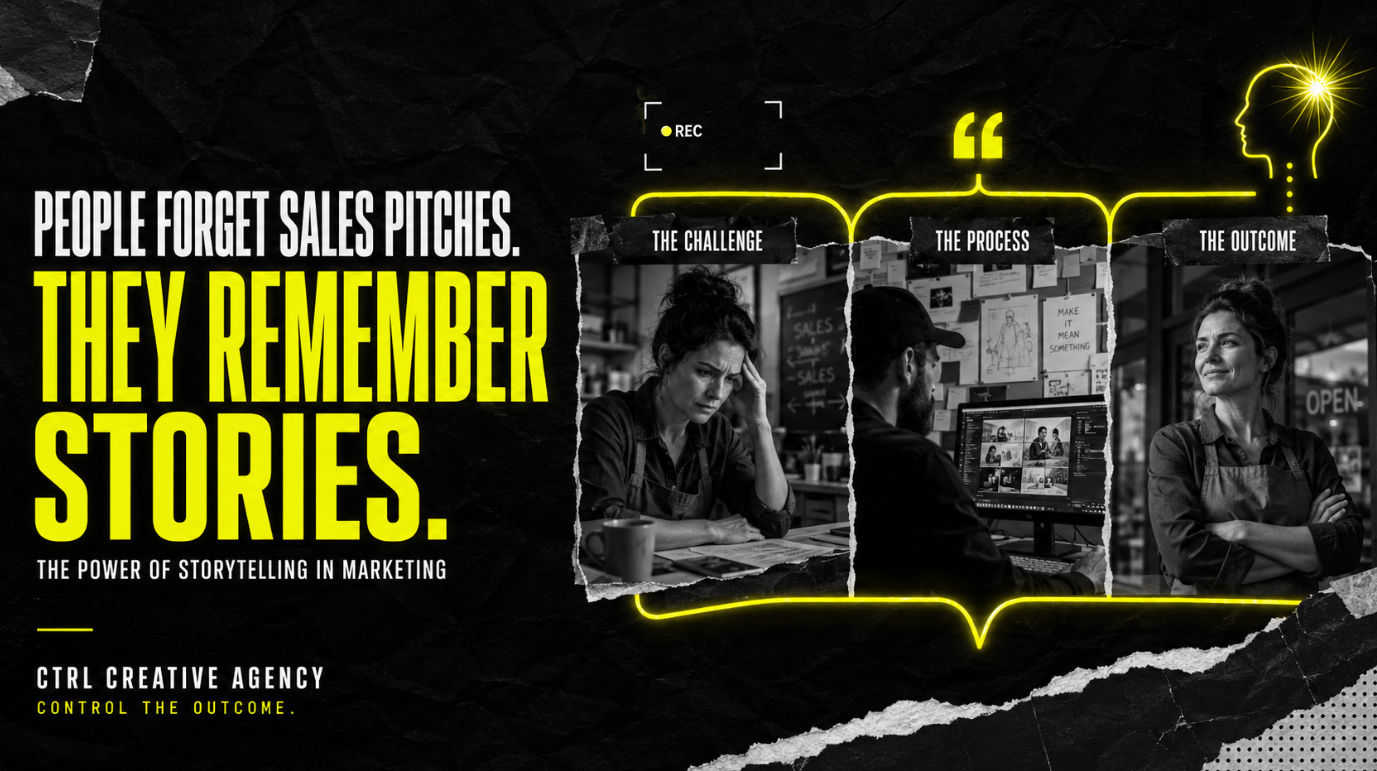

Most businesses do not have a content problem.
They have a meaning problem
They post their services, prices, products, promotions, awards, and availability—but never give people a reason to care.
The information may be accurate. The graphic may look professional. The offer may even be valuable.
But it still feels forgettable.
That is because people rarely connect with a business through a list of features.
They connect through problems, people, decisions, emotions, transformations, and experiences.
They connect through stories.
Marketing tells people what you sell. Storytelling helps them understand why it matters.
What Is Storytelling in Marketing?
Storytelling in marketing is the use of real experiences, people, challenges, and transformations to communicate the value of a business.
It does not mean inventing dramatic stories or turning every social media post into an emotional speech.
It means giving your audience enough context to understand:
- Who the business helps
- What problem existed
- Why the problem mattered
- What changed
- How the business contributed
- What the outcome meant
- Why someone should trust the process
Storytelling transforms an abstract service into something a potential customer can see, feel, and imagine for themselves.
“Commercial remodeling services” is information.
“An outdated medical office needed to remain functional during renovation, so the project was completed in phases to minimize disruption for patients and staff” is a story.
The service has not changed.
The meaning has.
Why Most Business Content Is Forgettable
Many businesses create content from the company’s perspective instead of the customer’s.
They post:
- We offer this.
- We won this.
- We are the best.
- We are accepting clients.
- We have years of experience.
- We use quality materials.
- We care about customers.
- Contact us today.
None of those statements are automatically wrong.
They are simply incomplete.
Customers want to understand:
- What can you help me solve?
- Have you handled a situation like mine?
- What will the experience be like?
- What makes your approach different?
- Why should I trust you?
- What result is possible?
- Will you understand what matters to me?
Storytelling answers those questions through evidence and context instead of empty claims.
A Story Gives the Customer a Place in the Message
Strong marketing does not always make the business the hero.
Often, the customer should be the central character.
The business becomes the guide, partner, expert, or resource that helps the customer move from a problem toward an outcome.
For example:
A contractor is not only renovating a restaurant.
The restaurant owner is trying to open on schedule, protect the investment, create an experience for guests, and begin generating revenue.
A chiropractor is not only performing an adjustment.
The patient may be trying to return to work, sleep comfortably, play with their children, or participate in an activity they have avoided because of pain.
A marketing agency is not only producing content.
The business owner may be trying to finally become visible, attract better clients, build credibility, or stop carrying the entire marketing workload alone.
A nonprofit is not only collecting donations.
It is trying to change what is possible for the people and community it serves.
The service matters because of what it allows someone else to do.
That is the story.
Storytelling Is Not the Same as Oversharing
A business does not need to share every private detail, struggle, disagreement, or emotional experience to appear authentic.
Effective brand storytelling is intentional.
It should support the audience, message, and purpose of the business.
Share stories that:
- Demonstrate expertise
- Explain the mission
- Build appropriate trust
- Show the process
- Highlight transformation
- Reinforce company values
- Educate potential customers
- Humanize the people behind the work
- Help someone feel understood
Avoid using personal information simply to attract attention.
Vulnerability without direction can feel uncomfortable or manipulative. Authenticity does not require abandoning boundaries.
The goal is not exposure.
The goal is connection.
The Five Elements of a Strong Marketing Story
A useful marketing story does not need to be long or complicated.
It needs five basic elements.
1. The Person
Who is at the center of the story?
This may be:
- A customer
- An employee
- The owner
- A partner
- A community member
- A donor
- A project stakeholder
- A group of people with a shared problem
The more specific the person, the easier it is for the audience to understand the stakes.
2. The Problem
What needed to change?
The problem should be relevant to the audience you want to reach.
Examples include:
- A website was receiving traffic but producing no leads.
- A restaurant needed to fill seats during slow weekday hours.
- A commercial property required extensive restoration after water damage.
- A business had strong referrals but almost no online presence.
- An event needed more than logo placement to deliver sponsor value.
- A customer felt overwhelmed by conflicting service options.
The problem gives the story tension and direction.
3. The Stakes
Why did the problem matter?
Without stakes, the content becomes a project description instead of a story.
The website was not simply outdated. It was creating doubt before potential customers ever called.
The restaurant was not simply quiet on Tuesdays. It was carrying the same staffing and operating costs without enough revenue.
The construction delay was not merely inconvenient. It threatened an opening date, vendor schedule, and months of planned revenue.
The stakes help people understand the real value of the solution.
4. The Process
What did the business do?
Show the thinking, decisions, strategy, work, communication, or expertise behind the result.
This is where many companies skip directly from “before” to “after.”
But the process is often where trust is built.
Explain:
- What you noticed
- What you recommended
- Why you made a decision
- How the work was completed
- What challenge appeared
- How your team responded
- What was adjusted along the way
The process proves that the outcome was not an accident.
5. The Transformation
What changed?
The outcome can be practical, emotional, or both.
Examples include:
- More qualified leads
- A completed renovation
- A successful opening
- Increased reservations
- Improved customer confidence
- A clearer brand
- A safer property
- Greater community participation
- A customer returning to an important activity
A strong transformation gives the audience something to imagine for themselves.
Turn Services Into Stories
Businesses often struggle with storytelling because they believe nothing interesting happens.
Usually, the story is already there. It simply has not been documented.
Instead of saying:
“We offer professional photography.”
Say:
“A growing business had strong work but relied on inconsistent phone photos. We created a professional image library that gave the company enough content for its website, proposals, Google Business Profile, social media, and advertising.”
Instead of saying:
“We provide construction documentation.”
Say:
“This commercial project was documented from demolition through completion, creating a visual record of progress, workmanship, site conditions, and decisions that stakeholders could review without being physically present.”
Instead of saying:
“We manage social media.”
Say:
“The business owner had been posting whenever there was time, with no consistent message or way to measure results. We built a content system around customer questions, proof, personality, and clear offers.”
The story does not replace the service.
It makes the service easier to understand.
Use the Founder’s Story Carefully
A founder’s story can be powerful because it explains the motivation, experience, or problem that created the business.
A strong founder’s story may include:
- What you noticed in the industry
- What frustrated you
- What you believed could be done differently
- What experience prepared you
- Why the work became personal
- Who you wanted to help
- What the company stands for today
But the founder’s story should eventually connect back to the customer.
The audience does not only need to know what happened to you.
They need to understand what your experience allows you to do for them.
The story is not:
“Look at everything I have overcome.”
It is:
“Because of what I have learned, I understand this problem differently—and that shapes how I serve people now.”
Show the Story Behind the Business
People often see the finished product without understanding what made it possible.
Show:
- Planning meetings
- Creative decisions
- Project preparation
- Early sketches
- Construction progress
- Mistakes that were corrected
- Quality-control processes
- Team coordination
- Vendor relationships
- Customer feedback
- The reasoning behind a strategy
Behind-the-scenes content works when it reveals something meaningful.
A random clip from your day may create activity.
A clip explaining why a decision matters creates insight.
The strongest behind-the-scenes content does not only show what happened.
It explains why the viewer should care.
Tell Customer Stories With Honesty
Customer stories and testimonials can be some of the most persuasive content a business creates.
They should also be truthful, accurate, and used with permission.
The Federal Trade Commission explains that testimonials are advertising messages people are likely to understand as reflecting a customer’s actual opinions, beliefs, or experiences. The FTC’s review and testimonial guidance makes clear that businesses should not create fake reviews or misrepresent customer experiences.
When sharing a customer story:
- Get permission.
- Protect private information.
- Represent the experience accurately.
- Do not exaggerate the result.
- Disclose relevant paid or gifted relationships.
- Avoid presenting an unusual result as guaranteed.
- Use the customer’s real meaning and experience.
Authentic proof is powerful.
Manufactured proof destroys trust.
Storytelling Works Across Every Marketing Channel
A good story should not live in only one post.
One customer or project story can become:
- A full website case study
- A short Reel
- A LinkedIn post
- An Instagram carousel
- A Facebook caption
- A customer testimonial video
- A Google Business Profile update
- An email
- A sales presentation
- A proposal example
- A blog
- A podcast conversation
- A media pitch
- An event presentation
This is not repeating the same message carelessly.
It is adapting a meaningful story to the way people consume information on different platforms.
A short Reel may show the transformation.
A blog can explain the complete process.
LinkedIn can focus on the business lesson.
Instagram can highlight the visual journey.
Email can connect the story to a relevant offer.
The story remains consistent while the format changes.
Stories Make Professional Content More Human
Professional does not have to mean emotionless.
Many companies remove every trace of personality because they want to appear credible.
The result is content that sounds like it was written by any business in the industry.
Compare:
“We are committed to delivering innovative, customer-focused solutions.”
With:
“When we started this project, the client had already spoken with three companies and still did not have a clear answer. Our first job was not to sell—it was to make the options understandable.”
The second version demonstrates customer focus instead of simply claiming it.
Specificity creates credibility.
Use Conflict Without Manufacturing Drama
Every useful story needs some form of tension.
In business storytelling, conflict can be:
- A confusing decision
- A tight deadline
- An outdated process
- A visibility problem
- An unexpected project condition
- A customer objection
- A crowded market
- A missed opportunity
- A difficult transition
- A gap between quality and perception
Conflict does not require turning another company, employee, or customer into the villain.
The problem is the obstacle.
Your content should show how the business approached that obstacle with clarity, care, or expertise.
Your Brand Values Need Evidence
Many businesses describe themselves with the same words:
- Innovative
- Authentic
- Customer-focused
- Community-driven
- Professional
- High-quality
- Honest
- Reliable
Those words do not become meaningful until the business demonstrates them.
If your business values community, tell the story of a partnership and explain what was accomplished together.
If you value customer service, show how your team responded when something did not go according to plan.
If you value quality, document the detail other companies might overlook.
If you value innovation, explain the problem a new approach solved.
Stories turn values into evidence.
Storytelling and SEO Work Together
Storytelling is not separate from search engine optimization.
Original project stories, expert explanations, customer questions, and real-world experience can make content more distinctive and useful.
Google recommends creating people-first content rather than material designed primarily to manipulate rankings. It also currently encourages businesses to develop unique, expert-led content that offers more value than generic information available everywhere. Google’s people-first content guidance and AI search optimization guidance both reinforce this approach.
A contractor’s real case study is more valuable than another generic article about choosing a contractor.
A restaurant’s story about developing a signature dish is more distinctive than a stock post saying the food is delicious.
A consultant’s explanation of an actual strategic decision is more credible than another list of broad business tips.
Real experience creates content competitors cannot easily duplicate.
Common Storytelling Mistakes
Avoid these common problems:
Making Every Story About the Business
The audience needs to understand what the story means for them.
Hiding the Point
A story should lead somewhere. Do not make people search for the connection.
Exaggerating
Dramatic language cannot replace accurate results.
Sharing Without Permission
Customer trust matters more than content.
Inventing Emotion
Do not force a sentimental angle onto a story that does not need one.
Removing All Specific Details
Vague stories feel manufactured. Include appropriate, concrete information.
Making the Business the Savior
Show expertise without diminishing the customer’s role.
Telling Stories Without Strategy
The story should reinforce the brand, audience, service, or business objective.
Confusing Activity With Meaning
Not every moment from the workday needs to become content.
A Simple Storytelling Framework
Use this framework when creating your next post, video, email, case study, or presentation:
Before: What was happening?
Problem: What needed to change?
Why it mattered: What was at risk?
Decision: What approach was chosen?
Process: What happened during the work?
Result: What changed?
Meaning: Why should the audience care?
For example:
Before: A contractor had relied on referrals for ten years.
Problem: The company had almost no digital presence and could not show its full commercial experience online.
Why it mattered: Potential clients searching online had little evidence of the company’s capabilities.
Decision: Build a complete system around the website, Google Business Profile, professional content, case studies, and outreach.
Process: Document projects, organize services, clarify positioning, and create content for the industries the contractor wanted to attract.
Result: The company gained a stronger foundation for visibility and business development.
Meaning: Great work cannot create new opportunities if the right people never see it.
That is a marketing story.
How to Find Stories Inside Your Business
Ask your team:
- Which project are we most proud of?
- When did we solve an unexpected problem?
- What do customers misunderstand before working with us?
- What customer feedback stayed with us?
- Why was the business started?
- Which decision changed the company?
- What do we do differently from competitors?
- What detail do customers rarely see?
- Which partnership created something meaningful?
- When did our process protect a customer from a larger problem?
- What has the business learned the hard way?
- What transformation best represents our work?
Document the answers.
You may have months of content sitting inside conversations your team is already having.
Do Not Just Show the Outcome—Show What It Took
The finished photo matters.
So does the process.
The grand opening matters.
So do the months of planning.
The completed building matters.
So do the decisions, setbacks, coordination, and craftsmanship that created it.
The successful campaign matters.
So do the research, positioning, testing, and adjustments behind the result.
When businesses show only polished outcomes, customers may appreciate the work without understanding its value.
Storytelling reveals what the result required.
That understanding can support trust, differentiation, and pricing.
Your Business Already Has Stories
You do not need to invent a brand story.
You need to pay closer attention to the stories happening inside the work.
They exist in:
- The customer who finally found the right solution
- The project that required creative problem-solving
- The employee who quietly maintains the standard
- The owner who started with an idea
- The community that supported the company
- The mistake that improved the process
- The partnership that created a larger opportunity
- The result that changed what was possible
The story is already there.
Your job is to recognize it, document it, and connect it to the people who need to hear it.
Stop Selling the Service Without Explaining the Significance
Customers can compare services, features, prices, and reviews.
What they cannot compare as easily is meaning.
Storytelling helps people understand why your business exists, why your approach is different, why the work matters, and what the experience could mean for them.
A story cannot compensate for a weak service or dishonest promise.
But when the work is strong, storytelling makes its value easier to see.
Your audience may forget the list of deliverables.
They may forget the exact caption.
They may forget the advertisement.
But they are more likely to remember the business that made them feel understood.
Turn Your Work Into a Story People Remember
CTRL Creative Agency helps businesses find and communicate the stories already living inside their work.
Through brand strategy, photography, videography, social media, websites, SEO, email and SMS marketing, public relations, community partnerships, events, and campaigns, we turn services and experiences into content with meaning.
You do not need more content simply for the sake of posting.
You need stories that make the right people understand why your business matters.
Visit CTRL Creative Agency or email hello@ctrlcreative.org to start the conversation.
Control The Outcome.
Leave a Reply