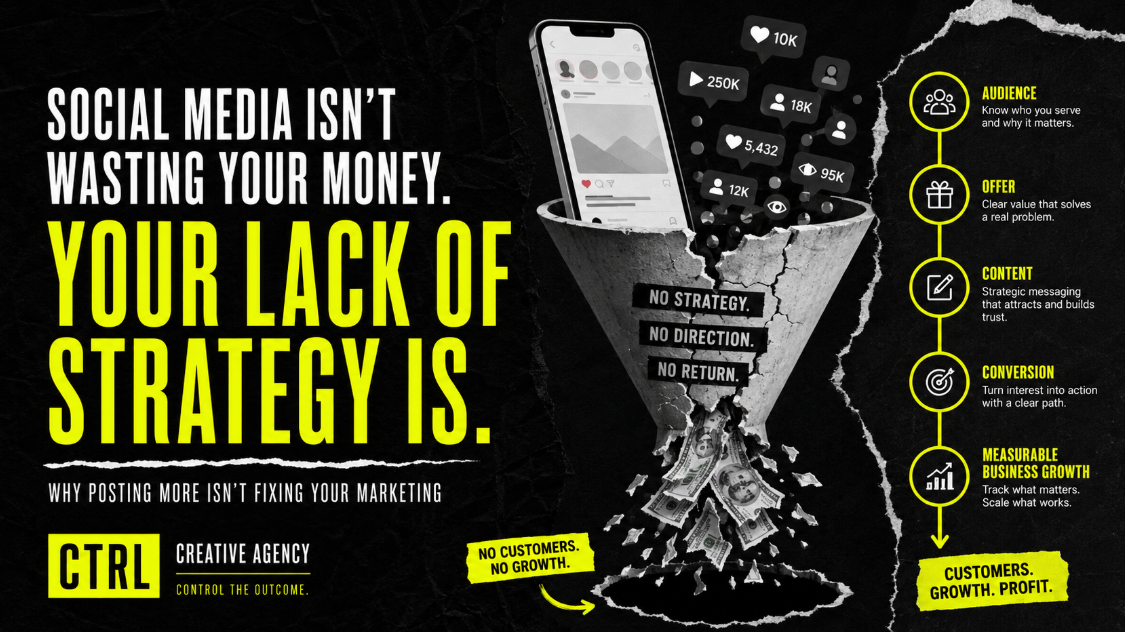

Here is the controversial truth:
Social media is not wasting your money. Your lack of strategy is.
Businesses spend hundreds—or thousands—of dollars every month on content creation, social media management, boosted posts, ads, influencers, videographers, graphic designers, and scheduling platforms.
They post consistently.
They follow trends.
They use popular audio.
They celebrate likes, views, and follower growth.
Then someone asks the question that actually matters:
“How much business did this generate?”
Suddenly, no one has a clear answer.
No one knows which content brought in customers, which platform created qualified leads, whether the ads produced revenue, or what the business was trying to accomplish in the first place.
That is not a social media problem.
That is a strategy problem.
Posting Is Not a Strategy
A content calendar is not automatically a marketing strategy.
Posting three times a week does not guarantee growth.
Creating Reels does not guarantee customers.
Hiring someone to keep the account active does not guarantee that the activity supports the business.
Posting is an action.
Strategy explains:
- Why the content is being created
- Who it is intended to reach
- What the audience should understand
- Which business goal it supports
- What action the viewer should take
- How success will be measured
- What happens after someone engages
Without those answers, businesses are often producing content simply because they believe they are supposed to.
That is how social media becomes an expense instead of an investment.
The Problem Is Not Always a Lack of Content
When social media is not producing results, the first reaction is often:
“We need to post more.”
Sometimes consistency is part of the issue.
But more content will not fix:
- An unclear offer
- Weak positioning
- Confusing branding
- The wrong audience
- Poor customer service
- An outdated website
- No lead follow-up
- Inconsistent messaging
- A difficult booking process
- Content with no call to action
- A service people do not understand
- A profile that does not establish trust
Increasing the volume of unclear content only makes the confusion louder.
Before creating more, determine whether the foundation is strong enough to support the attention.
Businesses Are Paying for Activity Instead of Outcomes
Many social media services are sold around deliverables:
- Twelve posts per month
- Eight Reels
- Four carousels
- Daily Stories
- Two content sessions
- Monthly reporting
Deliverables matter. A scope of work needs to be clear.
But a list of deliverables does not explain what those deliverables are designed to accomplish.
A business can receive every promised post and still see no meaningful improvement.
The better questions are:
- Which audience are we targeting?
- Which offer are we promoting?
- Which customer problem are we addressing?
- What stage of the customer journey does this content support?
- How will the content build trust?
- Where are we sending interested viewers?
- How will leads be captured?
- How will we know whether the campaign worked?
If the entire strategy is “we need to post consistently,” the business is paying for activity.
Not necessarily results.
Views Are Not Revenue
Views can be valuable.
They can increase awareness, introduce new people to a business, and provide information about what attracts attention.
But views alone do not prove that content is helping the business grow.
A Reel with 100,000 views may produce:
- No qualified inquiries
- No website visits
- No appointments
- No reservations
- No quote requests
- No purchases
- No relationship with the intended audience
Meanwhile, a highly specific video with 2,000 views may reach decision-makers and generate several valuable conversations.
The smaller video may be worth more.
The question is not only:
“How many people saw this?”
It is also:
“Did the right people see it, and did it move them closer to action?”
Followers Are Not Automatically Customers
A large following can create credibility and expand reach.
It can also create a false sense of success.
Follower count does not tell you:
- Whether followers are located in your service area
- Whether they fit your ideal customer profile
- Whether they can afford the offer
- Whether they understand what you sell
- Whether they trust the business
- Whether they have any intention of buying
- Whether they are real or active
- Whether they followed for content unrelated to the business
A restaurant needs people who can realistically visit.
A contractor needs property owners, developers, managers, and decision-makers—not only viewers who enjoy satisfying construction footage.
A chiropractor needs potential patients within a reasonable geographic area.
A consultant needs business owners with the right problems, budget, and readiness.
The goal is not to collect the largest possible audience.
The goal is to build the right one.
Most Businesses Have No Conversion Path
Imagine someone discovers your business through a Reel.
What happens next?
They may visit your profile—but then what?
Can they immediately understand:
- What the business does?
- Who it helps?
- Where it operates?
- What makes it different?
- Why it should be trusted?
- What the viewer should do next?
Does the profile lead to a useful website?
Does the website clearly explain the offer?
Is there a working contact form?
Can the person call, book, reserve, request a quote, or make a purchase easily?
Will anyone follow up?
Social media often gets blamed for failing when the actual breakdown happens after the click.
The content created attention.
The rest of the system failed to convert it.
Boosting a Post Is Not a Complete Advertising Strategy
The “Boost Post” button makes advertising feel simple.
Choose a budget, select an audience, and let the platform handle the rest.
But spending money on a post without a defined business goal can buy attention that leads nowhere.
Before paying to promote content, decide whether the goal is:
- Awareness
- Website traffic
- Messages
- Leads
- Appointments
- Reservations
- Event registrations
- Product sales
- Retargeting
- Repeat purchases
Meta’s own advertising guidance recommends selecting the campaign objective that best aligns with the larger business goal because its system uses that objective to find people more likely to take the related action. Meta’s campaign-objective guidance distinguishes between outcomes such as awareness, traffic, leads, and sales.
If you want leads but optimize only for engagement, you may receive exactly what you requested:
Engagement.
That does not mean you will receive customers.
Paid Ads Cannot Rescue a Weak Offer
Advertising can increase the number of people who see an offer.
It cannot force people to want it.
If an ad is not performing, the problem could be:
- The wrong audience
- Unclear messaging
- Weak creative
- Poor positioning
- An uncompetitive offer
- No urgency
- A confusing landing page
- A lack of trust
- A broken follow-up process
- An unrealistic expectation
- A mismatch between the advertisement and customer experience
Businesses sometimes continue increasing ad spend because they assume the campaign needs more data.
Sometimes the business needs a better strategy.
Paid reach amplifies what already exists.
If the message is strong, that amplification can create growth.
If the message is confusing, the business pays more people to ignore it.
Stop Creating Content for the Algorithm
The algorithm is not your customer.
It will not book an appointment.
It will not sign a contract.
It will not reserve a table.
It will not refer a friend.
It will not pay an invoice.
Platforms matter. Format matters. Retention matters. Trends, audio, timing, and editing can influence distribution.
But content created exclusively to satisfy an algorithm can lose its connection to the business.
You may gain views from a trend while teaching the audience nothing about:
- The problem you solve
- The quality of your work
- Your expertise
- Your values
- Your process
- Your offer
- The next step
Use platform best practices to improve delivery.
Do not let them replace the message.
Generic Content Is Becoming Easier to Ignore
Businesses have access to more templates, automated tools, stock assets, and AI-generated content than ever before.
That makes content production faster.
It also makes generic content easier to recognize.
Audiences repeatedly see:
- The same hooks
- The same motivational quotes
- The same templates
- The same recycled tips
- The same generic stock photos
- The same vague promises
- The same trends with a different logo
Content becomes valuable when it includes something competitors cannot copy easily:
- Firsthand experience
- A specific perspective
- Real customer questions
- Original photography
- Actual projects
- Honest lessons
- Local knowledge
- A recognizable voice
- A meaningful opinion
- Demonstrated expertise
Google’s guidance similarly emphasizes helpful, reliable, people-first content that provides original information, firsthand expertise, and value beyond what is already available. Google’s people-first content guidance is written for search, but the principle applies across content marketing: make something for real people, not merely for distribution systems.
You Do Not Need to Be on Every Platform
Every platform creates another demand for:
- Content
- Creative formatting
- Community engagement
- Messages
- Analytics
- Customer service
- Testing
- Consistency
A small business with limited time and resources may perform better by using two platforms intentionally than five platforms poorly.
Choose platforms based on:
- Where your audience spends time
- What type of content supports your service
- How customers research purchases
- Whether the platform supports your sales process
- What your team can sustain
- Which channels have produced meaningful results
A commercial contractor may find more qualified opportunities through Google, LinkedIn, case studies, email, and direct relationship-building than through daily TikTok videos.
A restaurant may benefit from Instagram, Facebook, Google Business Profile, creator partnerships, local groups, and email or SMS.
A personal brand may need consistent short-form video and direct audience engagement.
The correct platform is the one that connects your business with the right customer—not the one receiving the most attention from marketers this week.
Most Social Media Reports Measure the Wrong Things
A report filled with increasing impressions and engagement can look impressive.
But if the business needs customers, the report should connect activity to business outcomes.
Track metrics based on the goal.
Awareness Metrics
- Reach
- Impressions
- Video views
- Brand searches
- Profile visits
- Follower quality
Engagement Metrics
- Saves
- Shares
- Comments
- Replies
- Direct messages
- Watch time
- Content retention
Traffic Metrics
- Website visits
- Landing-page visits
- Link clicks
- Cost per landing-page view
- Source of traffic
Lead Metrics
- Calls
- Contact-form submissions
- Messages
- Consultations booked
- Quote requests
- Email signups
- Cost per qualified lead
Sales Metrics
- Purchases
- Reservations
- Contracts
- Revenue
- Customer-acquisition cost
- Return on advertising spend
- Repeat purchases
Not every post needs to generate a direct sale.
But the complete strategy should create measurable movement toward the business goal.
If You Cannot Track Everything, Track Something Useful
Perfect attribution is difficult.
A customer may:
- See a Reel.
- Search for the company later.
- Read reviews.
- Visit the website.
- Ask a friend.
- Return through Google.
- Call the business.
The final call may be credited to Google even though social media introduced the company.
That does not mean measurement is impossible.
Ask new customers:
- How did you hear about us?
- Which content did you see?
- What made you reach out?
- Did someone refer you?
- Which platform did you use?
Use:
- Website analytics
- Platform insights
- Contact-form fields
- Dedicated landing pages
- Trackable links
- Call tracking
- CRM notes
- Offer codes
- Booking data
- Campaign-specific questions
Meta also provides tools such as the Pixel and Conversions API to help connect website and customer actions with advertising activity. Meta’s Conversions API overview explains how this information can support ad optimization and measurement across the customer journey.
The goal is not to create a perfect spreadsheet.
It is to make better decisions with more evidence.
Social Media Cannot Fix a Bad Customer Experience
A strong campaign can attract attention quickly.
That attention can expose everything else just as quickly.
If customers encounter:
- Slow responses
- Unanswered messages
- Incorrect hours
- Poor service
- Complicated booking
- Inconsistent pricing
- Missed deadlines
- Weak communication
- An unprofessional website
- A different experience from what was advertised
The marketing may be working.
The business may not be ready for it.
Social media creates expectations.
The customer experience determines whether those expectations become trust—or disappointment.
Organic Marketing Is Not Free
Organic social media does not require paying for every impression.
That does not make it free.
It requires:
- Strategy
- Planning
- Writing
- Photography
- Video production
- Editing
- Design
- Publishing
- Engagement
- Reporting
- Time
- Expertise
A business owner creating everything personally is still investing time that could be used elsewhere.
The question is not whether organic content costs money.
The question is whether the investment is producing useful assets and business value.
One strong content day can produce:
- Website photography
- Reels
- Testimonials
- Case-study footage
- Google Business Profile updates
- Email content
- Advertising creative
- Sales materials
- Blog visuals
- Social posts
That is a content system.
A single trendy video with no connection to the business is merely a post.
Do Not Hire Social Media Management Before Defining the Business
A social media manager cannot create long-term clarity for a business that has not decided:
- Who it serves
- What it sells
- What it wants to be known for
- What makes it different
- Which offer matters most
- How leads will be handled
- What success looks like
A capable strategist can help the business answer those questions.
But if the engagement is limited to “make posts,” the deeper problems may remain untouched.
Before investing heavily in management, clarify:
- The target customer
- The primary offer
- The brand position
- The customer problem
- The desired conversion
- The customer journey
- The content pillars
- The measurement plan
Then the social media work has a foundation.
What a Real Social Media Strategy Should Include
A useful strategy should define:
The Business Goal
What are we trying to accomplish?
The Audience
Who needs to see the message?
The Offer
What do we want the audience to consider or purchase?
The Positioning
Why should the customer choose this business?
The Content Pillars
Which recurring themes will build awareness, trust, proof, and conversion?
The Platforms
Where will the content be distributed—and why?
The Customer Journey
What happens after someone discovers the business?
The Calls to Action
What should the audience do next?
The Production System
How will content be created efficiently and consistently?
The Measurement Plan
Which metrics will determine whether the strategy is working?
Without these elements, a calendar can organize content without improving the marketing.
Use Four Types of Content
A balanced social media strategy should include:
1. Discovery Content
This attracts the attention of people who may not know the business.
Examples:
- Strong opinions
- Timely topics
- Relatable problems
- Shareable education
- Entertaining industry content
- Collaborations
2. Trust Content
This helps people understand the business and the people behind it.
Examples:
- Behind-the-scenes videos
- Founder perspective
- Team introductions
- Process explanations
- Customer service standards
- Community involvement
3. Proof Content
This demonstrates that the business can deliver.
Examples:
- Testimonials
- Case studies
- Project results
- Before-and-after content
- Customer reactions
- Measurable outcomes
4. Conversion Content
This gives ready customers a reason and way to act.
Examples:
- Clear offers
- Appointment availability
- Reservations
- Product launches
- Consultations
- Event registration
- Quote requests
If every post is promotional, people stop listening.
If nothing is promotional, people may never realize they can buy.
When Social Media Is Worth the Investment
Social media becomes valuable when it:
- Reaches the right people
- Clarifies the business
- Builds recognition
- Demonstrates expertise
- Creates trust
- Supports customer research
- Drives useful traffic
- Produces qualified conversations
- Strengthens customer relationships
- Generates reusable marketing assets
- Supports sales and retention
- Connects to a larger growth system
The value may not always appear as an immediate purchase.
But there should be a defensible reason for the work and evidence that it is moving the business forward.
Stop Blaming the Platform
It is easy to blame declining reach, changing algorithms, crowded feeds, or customers with short attention spans.
Those challenges are real.
But they do not remove the business’s responsibility to create a clear strategy.
Before saying social media does not work, ask:
- Are we speaking to a specific audience?
- Is our offer clear?
- Does our content show proof?
- Is the profile credible?
- Is the website ready?
- Is there an obvious next step?
- Are messages answered?
- Are leads followed up?
- Are we measuring the right outcomes?
- Have we given the strategy enough time?
- Are we adjusting based on evidence?
Social media may not be the right primary channel for every business.
But you cannot make that decision responsibly if the original strategy was never clearly defined.
Social Media Is a Tool, Not the Entire Strategy
Social media can introduce people to your business.
Your brand helps them remember it.
Your website helps them understand it.
Your reviews help them trust it.
Your email and SMS systems help you follow up.
Your customer experience helps you retain them.
Your sales process helps turn interest into revenue.
No single platform should carry the entire responsibility for growth.
Businesses waste money when they treat social media as an isolated task instead of one part of a connected marketing system.
Your Business Does Not Need More Noise
You do not need to post simply to prove the business exists.
You need content that helps the right people:
- Discover you
- Understand you
- Trust you
- Choose you
- Return
- Refer others
That requires more than a trend, template, boosted post, or monthly deliverable count.
It requires direction.
Social media is not automatically a waste of money.
But marketing without strategy usually is.
Turn Social Media Into a Business System
CTRL Creative Agency helps businesses stop guessing and start marketing with purpose.
We connect brand strategy, content creation, photography, videography, Reels, websites, SEO, Google Business Profile, paid advertising, email and SMS marketing, community partnerships, and customer experience into a strategy built around real business goals.
If your business is posting consistently but still not reaching the right people, generating qualified leads, or understanding what is working, start with clarity.
Reach out for a free brand audit or consultation to identify where your visibility, messaging, customer journey, or marketing system may be falling short.
Visit CTRL Creative Agency or email hello@ctrlcreative.org.
Control The Outcome.
Leave a Reply