Marketing should do more than look good.
It should produce measurable results.
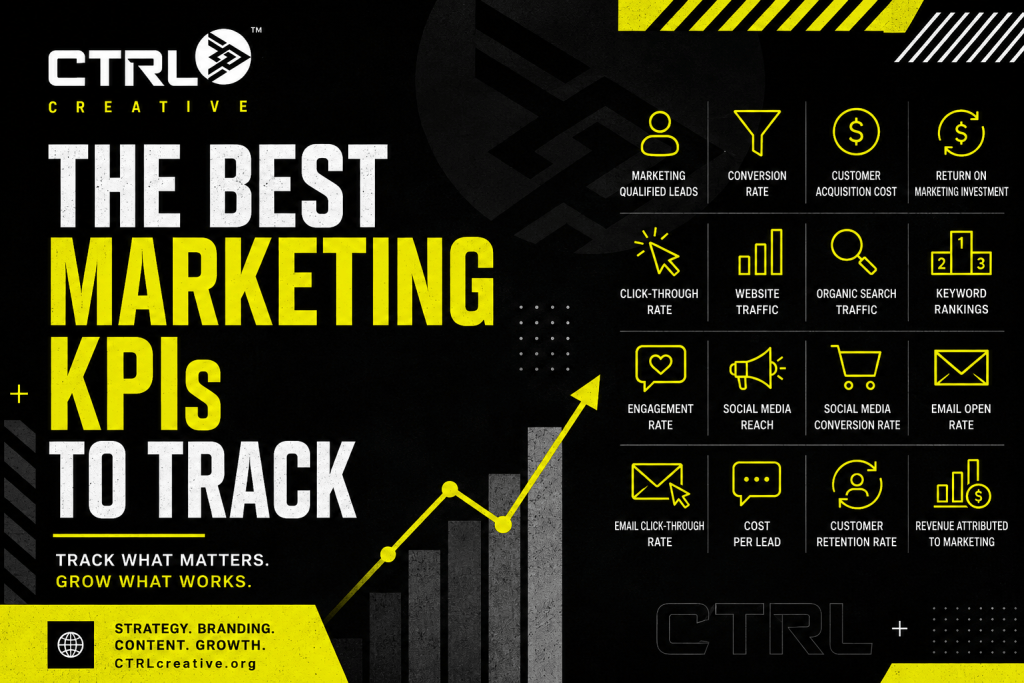
That is why understanding the best marketing KPIs to track is essential for any business that wants to grow strategically, improve performance, and make better decisions with its marketing budget.
KPIs, or key performance indicators, help you understand what is working, what is underperforming, and where your marketing dollars are actually making an impact.
Without the right numbers, marketing becomes guesswork.
With the right KPIs, you can build a strategy around real data.
What Are Marketing KPIs?
Marketing KPIs are measurable values used to evaluate the performance of your marketing efforts.
They can help you track things like:
- Lead generation
- Website traffic
- Sales
- Conversion rates
- Customer acquisition
- Revenue
- Social media performance
- Email marketing
- Advertising effectiveness
- Customer retention
The most important thing to understand is that not every metric is a KPI.
A metric is simply a number.
A KPI is a number directly connected to a business objective.
For example, Instagram likes may be a useful metric.
But if your primary goal is generating sales leads, your actual KPI may be the number of qualified leads generated from Instagram.
That distinction matters.
Why Marketing KPIs Matter
Tracking the right marketing KPIs allows you to make informed decisions instead of relying on assumptions.
When you understand your numbers, you can identify:
- Which campaigns generate the strongest results
- Which platforms produce the best customers
- Where your marketing budget should increase
- Where you may be wasting money
- Which content generates action
- How efficiently you acquire customers
- Whether your marketing efforts are contributing to revenue
Your KPIs should help answer one simple question:
Is our marketing helping the business move forward?
Here are some of the most important marketing KPIs to monitor.
1. Marketing Qualified Leads
A marketing qualified lead, or MQL, is someone who has shown meaningful interest in your business and is more likely to become a customer.
Examples may include someone who:
- Fills out a contact form
- Requests a quote
- Downloads a resource
- Books a consultation
- Joins your email list
- Responds to a campaign
- Sends a direct message asking about your services
Tracking qualified leads is more valuable than simply tracking how many people saw your content.
Visibility is important.
But visibility that generates opportunity is even better.
2. Conversion Rate
Your conversion rate measures the percentage of people who complete a desired action.
For example, if 1,000 people visit your landing page and 50 people submit a form, your conversion rate is 5%.
Conversions can include:
- Purchases
- Bookings
- Form submissions
- Phone calls
- Newsletter signups
- Downloads
- Consultation requests
Tracking conversion rates can help you identify whether your website, content, offers, and calls to action are actually persuading people to take the next step.
3. Customer Acquisition Cost
Customer acquisition cost, or CAC, measures approximately how much your business spends to gain one new customer.
A simple formula is:
Total Marketing and Sales Costs ÷ New Customers Acquired = Customer Acquisition Cost
For example:
If your business spends $2,000 on marketing and gains 20 new customers, your CAC is approximately $100.
This KPI becomes especially important when compared to the value of each customer.
If acquiring a customer costs $100 but they generate $2,000 in revenue, that may be a strong return.
If you spend $300 to acquire someone who only generates $150, your strategy may need adjustment.
4. Return on Marketing Investment
Return on marketing investment, often called ROMI or marketing ROI, helps measure the financial return generated from marketing activities.
This is one of the most important KPIs for business owners because it connects marketing directly to revenue.
You want to understand:
How much revenue are we generating compared to what we are investing?
Marketing ROI can help you compare campaigns and determine where your budget is performing most effectively.
5. Cost Per Lead
Cost per lead measures how much your business spends to generate one lead.
For example:
If you spend $500 on a campaign and generate 25 leads, your cost per lead is $20.
Tracking this number over time can help you determine which marketing channels are most efficient.
You may discover that:
- Google Ads produce higher-quality leads
- Instagram produces cheaper leads
- Email marketing generates the strongest conversions
- Organic SEO generates leads at a lower long-term cost
Knowing your cost per lead can make your marketing budget much more strategic.
6. Website Traffic
Website traffic shows how many people are visiting your website.
But the number of visitors alone does not tell the entire story.
Pay attention to where that traffic comes from.
Common traffic sources include:
- Organic Google searches
- Social media
- Paid advertising
- Referral websites
- Email campaigns
- Direct traffic
Tracking traffic sources can help you understand which marketing efforts are actually bringing people into your digital ecosystem.
7. Organic Search Traffic
If SEO is part of your strategy, organic search traffic is one of the most important marketing KPIs to track.
Organic traffic shows how many people discover your website through unpaid search engine results.
Strong organic traffic can indicate that your website is becoming more visible for keywords related to your services.
Over time, SEO can become one of the most valuable sources of leads because your website continues attracting potential customers without paying for every click.
8. Keyword Rankings
Keyword rankings show where your website appears in search engine results for specific search terms.
For example, a Kansas City marketing agency may want to rank for searches such as:
- Marketing agency Kansas City
- Social media management Kansas City
- Small business marketing strategy
- Branding agency Kansas City
- Content creation Kansas City
Improving these rankings can increase website visibility and organic traffic.
However, rankings should always be evaluated alongside traffic, leads, and conversions.
Ranking number one means very little if the keyword never generates business.
9. Click-Through Rate
Click-through rate, or CTR, measures the percentage of people who click after seeing a link, advertisement, email, or search result.
You may track CTR for:
- Google Ads
- Facebook and Instagram Ads
- Email campaigns
- Search engine listings
- Social media posts
- Landing pages
A low click-through rate may indicate that your headline, visual, offer, or call to action is not strong enough.
A strong CTR often means your marketing message is successfully creating interest.
10. Social Media Reach
Social media reach measures how many unique people see your content.
Reach can help determine whether your brand is expanding beyond its current audience.
This is particularly valuable for businesses focused on brand awareness.
However, reach should not be evaluated alone.
You should also monitor what happens after people see your content.
Are they:
- Visiting your profile?
- Clicking your website?
- Following your account?
- Sending a message?
- Saving the post?
- Sharing it?
- Making a purchase?
Reach creates opportunity.
Action creates results.
11. Engagement Rate
Engagement rate measures how actively people interact with your social media content.
Engagement can include:
- Comments
- Shares
- Saves
- Likes
- Replies
- Direct messages
Shares, saves, and meaningful comments can often be more valuable than simple likes because they indicate stronger audience interest.
Strong engagement can also help you identify which topics resonate most with your audience.
12. Social Media Conversion Rate
One of the most overlooked social media KPIs is conversion rate.
Businesses often focus heavily on follower count.
But followers do not automatically equal customers.
Instead, track how many people move from social media into your sales process.
That may include:
- Website clicks
- Purchases
- Reservations
- Consultation requests
- Email signups
- Phone calls
- DMs
- Quote requests
A smaller audience that consistently generates business can be far more valuable than a massive audience that never converts.
13. Email Open Rate
Email open rate measures how many people open your emails compared to the number delivered.
It can help you understand whether your subject lines and sender reputation are generating attention.
However, open rate should not be your only email KPI.
It is possible to have strong open rates with weak results.
You should also track clicks and conversions.
14. Email Click-Through Rate
Email click-through rate measures how many recipients click a link within your email.
This is often more valuable than open rate because it shows that the reader took an additional action.
If people consistently open your emails but rarely click anything, your message, offer, or call to action may need improvement.
15. Customer Lifetime Value
Customer lifetime value, or CLV, estimates how much revenue an average customer generates during their relationship with your business.
This number can dramatically change how you think about marketing.
Imagine that it costs $200 to acquire a customer.
At first, that may seem expensive.
But if the average customer spends $5,000 with your company over several years, that $200 acquisition cost may be extremely profitable.
Customer lifetime value helps you understand how aggressively you can afford to invest in acquiring the right customers.
16. Customer Retention Rate
Marketing is not only about finding new customers.
Strong marketing also helps existing customers stay engaged with your business.
Customer retention rate measures how effectively you keep customers over time.
Retention is particularly important for businesses with:
- Monthly retainers
- Memberships
- Subscriptions
- Repeat services
- Restaurants
- Salons
- Professional services
A strong retention strategy can often increase revenue without requiring the same cost as acquiring new customers.
17. Revenue Attributed to Marketing
Ultimately, businesses need to understand how marketing contributes to revenue.
Revenue attribution attempts to identify which marketing channels or campaigns influenced a sale.
For example:
A customer might first discover you through Instagram.
Then visit your website.
Then read a blog article.
Then join your email list.
Then book a consultation two weeks later.
Marketing attribution helps connect those touchpoints.
Understanding the customer journey can help you determine which channels deserve more investment.
Vanity Metrics vs. Meaningful Marketing KPIs
One of the biggest mistakes businesses make is confusing popularity with performance.
Vanity metrics can include things like:
- Followers
- Likes
- Impressions
- Views
These numbers are not useless.
They can be valuable indicators of visibility and brand awareness.
The problem occurs when businesses treat them as the final measure of success.
A video receiving 500,000 views sounds impressive.
But what happened afterward?
Did people visit the website?
Did they follow?
Did they request information?
Did they purchase?
Did they book?
Did the campaign increase revenue?
Marketing should create more than attention.
It should create movement.
How Many Marketing KPIs Should You Track?
You do not need to monitor every possible KPI.
In fact, tracking too many numbers can make your marketing reports harder to understand.
Start with KPIs directly connected to your primary goals.
For example, a service-based business focused on growth may prioritize:
- Qualified leads
- Conversion rate
- Cost per lead
- Customer acquisition cost
- Revenue generated
- Customer lifetime value
A brand focused heavily on awareness may also prioritize:
- Reach
- Website traffic
- Engagement
- Search visibility
- Brand mentions
Your KPI dashboard should make it easy to understand whether your strategy is moving in the right direction.
Review Your KPIs Regularly
Marketing KPIs should not be reviewed once a year.
Depending on your business and campaign volume, evaluate performance:
- Weekly
- Monthly
- Quarterly
Look for trends rather than reacting to every small change.
One bad week does not automatically mean a strategy failed.
Likewise, one viral post does not automatically mean your entire marketing strategy is successful.
Marketing performance should be evaluated over time.
Track What Moves the Business Forward
The best marketing KPIs are not necessarily the numbers that look the most impressive.
They are the numbers that help you make better decisions.
Your marketing should tell you:
- Where customers are coming from
- What content influences them
- How much it costs to acquire them
- What turns attention into action
- What generates revenue
- Where you should invest next
That is how marketing becomes a growth system instead of another business expense.
At CTRL Creative, we help businesses build marketing strategies that go beyond aesthetics and vanity metrics.
From branding and content to social media, SEO, and growth strategy, the goal is simple:
Create marketing that can be measured, improved, and scaled.
Because strong marketing is not about chasing numbers.
It is about knowing which numbers matter.
Control the outcome.
Visit www.ctrlcreative.org to learn more about marketing strategy, branding, content creation, SEO, and business growth.
Leave a Reply