
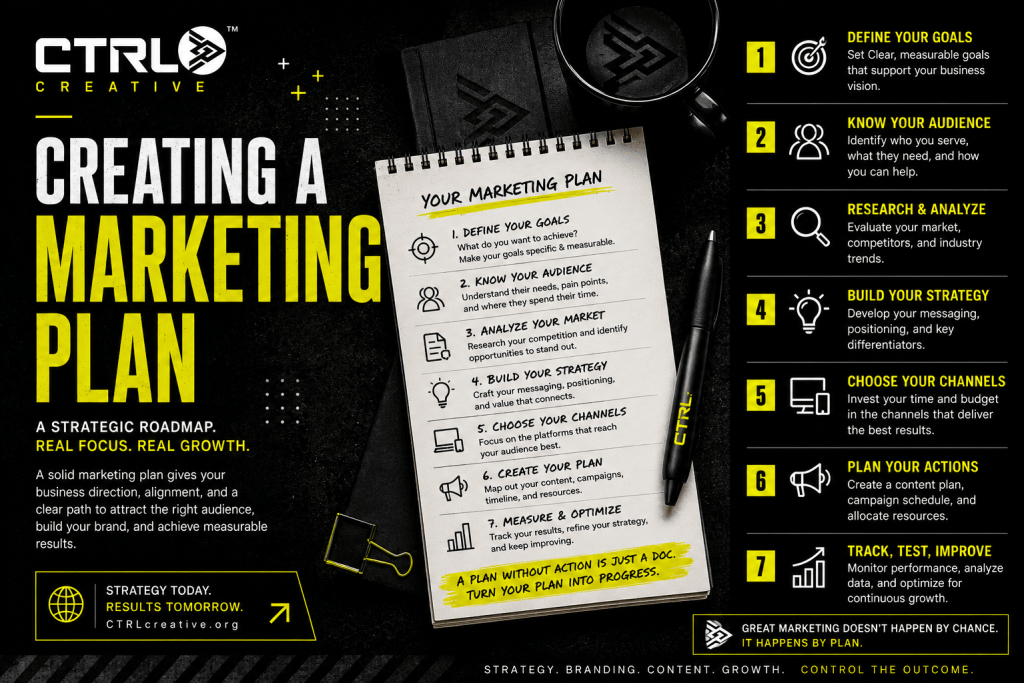
Marketing without a plan can feel busy without actually moving the business forward.
You post on social media.
You update the website.
You try an email campaign.
You sponsor an event.
You run a promotion.
But if those efforts are not connected to a larger strategy, it becomes difficult to know what is actually working.
That is why creating a marketing plan is one of the most important steps a business can take before investing heavily in marketing.
A strong marketing plan gives your business direction.
It helps you understand who you are trying to reach, what you want them to do, how you are going to reach them, how much you can invest, and how you will measure success.
Instead of guessing, you create a roadmap.
What Is a Marketing Plan?
A marketing plan is a strategic document that outlines how a business will promote its products or services, reach its ideal customers, and accomplish specific business goals.
Your marketing plan may include:
- Business goals
- Target audience
- Competitive research
- Brand positioning
- Marketing channels
- Content strategy
- SEO
- Social media
- Email marketing
- Advertising
- Partnerships
- Marketing budget
- Key performance indicators
- Campaign timelines
A marketing plan does not need to be 100 pages long.
It needs to be clear enough that everyone involved understands:
Where are we going?
Who are we trying to reach?
What are we going to do?
How will we know if it worked?
Why Creating a Marketing Plan Matters
Without a marketing plan, businesses often react instead of strategize.
They may jump from trend to trend, post inconsistently, invest in random campaigns, or spend money simply because another business is doing the same thing.
A plan gives marketing purpose.
It helps your business:
- Stay consistent
- Prioritize the right channels
- Create stronger messaging
- Spend money more strategically
- Measure performance
- Understand customers
- Set realistic goals
- Improve accountability
- Build long-term momentum
The goal is not to do everything.
The goal is to do the right things consistently.
Step 1: Define Your Business Goals
Your marketing strategy should support your business strategy.
Before deciding what to post or where to advertise, determine what the business actually needs to accomplish.
Examples include:
- Generate more qualified leads
- Increase monthly revenue
- Increase restaurant traffic
- Book more appointments
- Enter a new market
- Launch a new product
- Increase customer retention
- Grow brand awareness
- Improve website traffic
- Increase online sales
- Build a stronger local presence
Make goals specific whenever possible.
Instead of:
“We need more customers.”
Try:
“We want to generate 30 qualified leads per month over the next six months.”
Now marketing has a measurable target.
Step 2: Understand Your Target Audience
You cannot build an effective marketing plan without understanding who you are marketing to.
Start by identifying your ideal customer.
Consider:
- Age
- Location
- Income
- Industry
- Lifestyle
- Interests
- Buying habits
- Challenges
- Goals
- Priorities
- Objections
But demographics alone are not enough.
You also need to understand why they buy.
What problem are they trying to solve?
What are they frustrated by?
What would make their life or business easier?
What is stopping them from purchasing?
What do they value most?
Marketing becomes much stronger when your customer feels like your message was created specifically for them.
Step 3: Research Your Competition
Competitive research does not mean copying competitors.
It means understanding the environment your business operates in.
Look at:
- Competitor websites
- Google rankings
- Social media presence
- Customer reviews
- Offers
- Pricing
- Brand positioning
- Content strategy
- Advertising
- Customer experience
Ask yourself:
What are competitors doing well?
Where are they weak?
What are customers consistently praising?
What are customers complaining about?
What opportunities are being ignored?
The goal is to identify where your business can create a stronger position.
Step 4: Establish Your Brand Positioning
Your marketing plan should clearly explain why customers should choose you.
That is your positioning.
Ask:
What do we want to be known for?
Who do we serve best?
What makes our approach different?
Why should someone choose us instead of a competitor?
Strong positioning makes marketing easier.
For example, instead of trying to be:
“A marketing agency for everyone.”
A company might position itself as:
“A growth-focused creative agency helping service businesses turn branding and content into measurable business results.”
Specific positioning helps customers recognize when your business is right for them.
Step 5: Define Your Core Marketing Message
Customers should be able to quickly understand what your business offers and why it matters.
Your core messaging should communicate:
- What you do
- Who you help
- What problem you solve
- What outcome you create
- Why your approach is different
Avoid relying only on clever language.
Clarity usually converts better than confusion.
A strong brand can be creative and clear at the same time.
Step 6: Choose the Right Marketing Channels
Your business does not need to be everywhere.
It needs to be where your customers are.
Possible marketing channels include:
- SEO
- TikTok
- YouTube
- Google Business Profile
- Paid advertising
- Networking
- Influencer marketing
- Public relations
- Events
- Strategic partnerships
- Direct outreach
Choose channels based on customer behavior—not personal preference.
A construction company may benefit heavily from Google search, local SEO, video case studies, and referral relationships.
A fashion brand may prioritize Instagram, TikTok, creator partnerships, email marketing, and user-generated content.
The right strategy depends on the audience.
Step 7: Build a Content Strategy
Content should support your business goals.
Instead of randomly posting, create content categories that serve different purposes.
Educational Content
Teach customers something useful.
Answer common questions.
Explain your process.
Address misconceptions.
Authority Content
Demonstrate expertise.
Share insights.
Explain industry trends.
Offer strong opinions backed by experience.
Social Proof
Show:
- Testimonials
- Reviews
- Case studies
- Customer results
- Before-and-after examples
- Completed projects
Brand Content
Show personality, culture, values, behind-the-scenes moments, and the people behind the company.
Conversion Content
Tell people what you sell.
Explain your offers.
Give customers a clear next step.
A strong content strategy balances visibility with conversion.
Step 8: Build SEO Into the Plan
SEO should not be something you think about after the website is finished.
Search visibility should be part of the overall marketing strategy.
Identify the questions and phrases customers search when they need your services.
Then create:
- Service pages
- Location pages
- Blog articles
- FAQs
- Case studies
- Google Business Profile content
Organic search can become a major lead-generation channel over time.
The work compounds.
A strong article published today can continue attracting visitors months or years later.
Step 9: Create a Marketing Budget
Your plan needs resources behind it.
Determine how much your business can realistically invest into marketing each month or quarter.
Your marketing budget may include:
- Content production
- Social media management
- Paid advertising
- Website development
- SEO
- Photography
- Video
- Email software
- Design
- Events
- Influencer partnerships
- Public relations
- Marketing consultants or agencies
Do not simply ask:
“How little can we spend?”
Ask:
“What level of investment supports the growth we are trying to achieve?”
Your budget should align with your goals.
Step 10: Create a Marketing Calendar
Strategy needs execution.
Build a calendar showing what will happen and when.
Your marketing calendar may include:
- Campaign launches
- Content days
- Social media posts
- Blog publishing
- Email campaigns
- Seasonal promotions
- Events
- Partnerships
- Product launches
- Monthly reporting
Planning ahead reduces last-minute marketing.
Instead of asking what to post every morning, your team already understands the larger story being told.
Step 11: Create Clear Calls to Action
Attention is not enough.
Potential customers need to know what to do next.
Calls to action might include:
- Book a Consultation
- Request a Quote
- Make a Reservation
- Shop Now
- Download the Guide
- Call Today
- Join the Email List
- Request a Free Audit
- Schedule an Appointment
Your website, social content, emails, and campaigns should guide customers through the next step.
Do not assume they will figure it out.
Step 12: Decide Which Marketing KPIs to Track
A marketing plan needs measurement.
Otherwise, you cannot determine whether the strategy is working.
Depending on your goals, track:
- Qualified leads
- Conversion rate
- Website traffic
- Organic search traffic
- Cost per lead
- Customer acquisition cost
- Marketing ROI
- Revenue
- Engagement
- Email clicks
- Customer retention
- Customer lifetime value
Do not track numbers simply because they look impressive.
Track the numbers connected to business growth.
A viral post may create awareness.
But if the goal is lead generation, you also need to know how many people took action.
Step 13: Review and Adjust the Plan
Your marketing plan should not be created once and forgotten.
Marketing changes.
Customers change.
Platforms change.
Competitors change.
Your business changes.
Review performance monthly and evaluate the bigger strategy quarterly.
Ask:
What is working?
What is not working?
Where are our best leads coming from?
Which content is driving action?
What should we stop doing?
Where should we invest more?
A good marketing plan provides structure without preventing adaptation.
Example of a Simple Marketing Plan
Imagine a local service business wants to increase qualified leads.
Its plan might look like this:
Goal: Generate 40 qualified leads per month.
Audience: Homeowners within a 30-mile service radius.
Positioning: Premium service with fast communication and a transparent process.
Primary channels: Google, Instagram, Facebook, email, referrals.
Content: Two educational videos weekly, one case study, customer reviews, before-and-after content, and one SEO article monthly.
Lead strategy: Google Business Profile, local SEO, website quote form, referral partners, and social media calls to action.
Budget: $3,000 per month.
KPIs: Leads, website conversions, search traffic, cost per lead, booked jobs, revenue.
Suddenly marketing is no longer random.
Every activity serves a larger objective.
Common Marketing Plan Mistakes
One of the biggest mistakes is trying to do too much.
More platforms do not automatically mean more growth.
Other common mistakes include:
- No clear target audience
- No measurable goal
- No consistent budget
- Posting without strategy
- Copying competitors
- Ignoring SEO
- Measuring only followers and likes
- Changing strategies too quickly
- No clear calls to action
- Failing to follow up with leads
Marketing becomes much easier to improve once you can identify where the system is breaking.
Creating a Marketing Plan Gives Your Business Control
Businesses often feel frustrated with marketing because everything feels disconnected.
The website does one thing.
Social media does another.
Ads promote something else.
Sales conversations use completely different messaging.
A strong marketing plan connects those pieces.
Your branding supports your positioning.
Your content supports your message.
Your SEO supports discovery.
Your website supports conversion.
Your reviews support trust.
Your sales process supports the final decision.
Everything begins working together.
At CTRL Creative, we help businesses create marketing strategies built around growth—not random activity.
From branding and content to SEO, social media, customer experience, and business development, the goal is to build a marketing system where every move has a purpose.
Because when you understand where you are going, you can make better decisions about how to get there.
Control the Outcome.
Leave a Reply