Before most customers call a business, book a service, visit a restaurant, or make a purchase, there is a good chance they do one thing first:
They check the reviews.
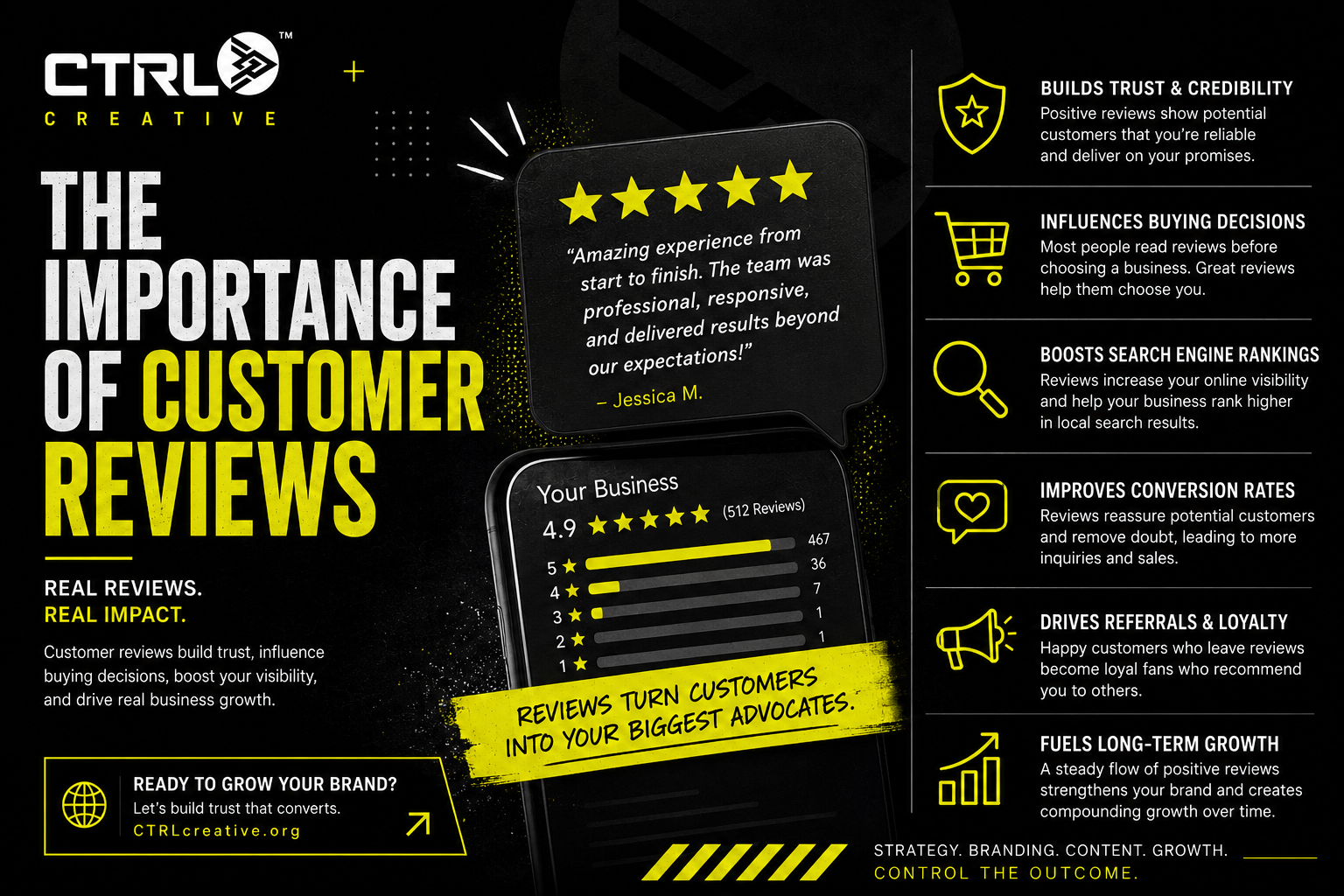
Customer reviews have become one of the strongest forms of modern word-of-mouth marketing. They influence trust, purchasing decisions, search visibility, brand reputation, and even how much someone is willing to spend.
That is why understanding the importance of customer reviews is essential for businesses trying to grow.
A strong review strategy is not simply about collecting five-star ratings.
It is about building proof that tells potential customers:
Other people chose us, trusted us, and had a positive experience.
And that proof can be incredibly powerful.
Why Are Customer Reviews Important?
Customer reviews give potential buyers information that traditional advertising cannot provide as easily:
An outside opinion.
Businesses naturally talk about their own strengths.
They tell customers they offer great service, quality products, professional experiences, and strong results.
Reviews validate those claims.
When customers see real people discussing their experience, the business becomes more believable.
Customer reviews can influence:
- Brand trust
- Purchasing decisions
- Local SEO
- Google visibility
- Conversion rates
- Customer confidence
- Business reputation
- Referral opportunities
- Customer loyalty
In many industries, your online reputation may influence the sale before you ever have a chance to speak with the customer.
1. Customer Reviews Build Trust
Trust is one of the biggest barriers between interest and purchase.
A potential customer may like your website.
They may enjoy your content.
They may even be interested in your service.
But they still want reassurance that choosing you is a good decision.
Reviews provide that reassurance.
A customer describing a positive experience feels different from a business describing itself.
Instead of:
“We provide exceptional customer service.”
A review might say:
“They responded quickly, explained everything clearly, and made the entire process easy.”
Both communicate the same strength.
But one comes directly from another customer.
That makes it more powerful.
2. Reviews Influence Buying Decisions
Reviews play an important psychological role in the buying process.
When customers feel uncertain, they look for evidence that other people have already made the same decision successfully.
This is known as social proof.
Potential customers begin thinking:
“Other people trusted them.”
“People seem happy with the results.”
“This company looks established.”
“If it worked for them, it may work for me.”
This lowers perceived risk.
And the lower the perceived risk, the easier it becomes to make a purchase.
3. Reviews Can Improve Local SEO
Customer reviews are especially valuable for local businesses.
When someone searches:
Marketing agency near me
Best restaurant in Kansas City
Barber near me
Roofing company Kansas City
Photographer near me
Google wants to provide useful, reputable local results.
Your Google Business Profile, customer reviews, business information, relevance, and overall online presence can all contribute to how visible your business becomes in local search.
Consistent reviews also keep your profile active and provide additional context about the products and services customers associate with your business.
For local companies, review generation should be part of the overall SEO strategy—not treated as an afterthought.
4. Reviews Create Powerful Social Proof
Marketing becomes stronger when people can see evidence.
You can say:
“Our clients love working with us.”
Or you can show five customers explaining exactly why.
The second option is more convincing.
Strong reviews can be repurposed across:
- Websites
- Social media
- Sales presentations
- Proposals
- Email campaigns
- Landing pages
- Case studies
- Service pages
- Print marketing
One great customer review can become an entire piece of marketing content.
That is why reviews should not remain hidden inside Google, Facebook, Yelp, or another review platform.
Use them.
5. Reviews Help Customers Understand the Experience
Customers often want to know more than whether your product works.
They want to understand what working with your business actually feels like.
Reviews can answer questions such as:
Was the company responsive?
Was the process easy?
Did they communicate clearly?
Was the service worth the investment?
Did the final result match expectations?
Would the customer hire them again?
These details reduce uncertainty.
And uncertainty is one of the biggest reasons customers hesitate.
6. Reviews Can Increase Conversions
Imagine two businesses offer nearly identical services.
One has two reviews.
The other has 150 positive reviews explaining the experience, service quality, and results.
Which business feels safer?
For many customers, the second business immediately appears more established.
That confidence can directly influence conversion.
Reviews can help turn:
Website visitors into inquiries.
Profile viewers into followers.
Searchers into callers.
Potential customers into buyers.
The goal is not simply collecting reviews for appearance.
The goal is using reputation to reduce the friction between discovery and purchase.
7. Reviews Give Businesses Valuable Feedback
Not every review needs to become an advertisement.
Reviews also provide valuable business intelligence.
Look for patterns.
If customers repeatedly praise:
- Communication
- Speed
- Quality
- Friendliness
- Creativity
- Professionalism
- Convenience
Those may be strengths worth emphasizing in your marketing.
Likewise, if customers repeatedly mention the same frustration, that may reveal something that needs improvement.
Customer feedback can help refine:
Your services.
Your processes.
Your messaging.
Your customer experience.
Your marketing strategy.
Sometimes your customers can explain your strongest selling point better than you can.
Pay attention to the words they use.
8. Negative Reviews Are Not Always a Disaster
No business wants negative reviews.
But one imperfect review does not automatically destroy a strong reputation.
In fact, the way a business responds can sometimes matter almost as much as the review itself.
If someone leaves legitimate criticism, respond professionally.
Avoid becoming defensive.
A strong response might:
Acknowledge the customer’s concern.
Clarify the situation when necessary.
Offer an appropriate way to resolve the issue.
Take the conversation offline if personal details are involved.
Potential customers may read your response.
They are not only evaluating the complaint.
They are evaluating how your business handles problems.
Professionalism during a difficult situation can still build trust.
9. Consistency Matters More Than One Review Campaign
Some businesses suddenly realize they need reviews and ask everyone at once.
Then they stop.
Six months later, their profile looks inactive again.
Review generation should be consistent.
Build it into your normal customer journey.
For example:
After completing a service.
After a successful appointment.
After delivering a project.
After receiving positive customer feedback.
After an event.
After a repeat purchase.
The best time to ask for a review is often when the customer is already expressing satisfaction.
Make the process easy.
Give them a direct review link whenever possible.
10. Make Asking for Reviews Part of the Customer Experience
Businesses sometimes avoid asking for reviews because it feels awkward.
It does not have to.
Try something simple:
“We’re glad you enjoyed your experience! If you have a minute, we’d really appreciate an honest Google review. It helps people looking for businesses like ours feel confident choosing us.”
That request explains why the review matters without pressuring the customer.
You can request reviews through:
- Follow-up emails
- Text messages
- QR codes
- Receipts
- Thank-you pages
- Business cards
- Post-service messages
- Email signatures
The easier you make it, the more likely customers are to follow through.
11. Respond to Positive Reviews Too
Businesses often respond only when something goes wrong.
Positive reviews deserve attention too.
Thank the customer.
Personalize the response when possible.
Mention something relevant about their experience.
This shows future customers that your company appreciates the people supporting it.
It also turns your review section into another customer interaction point.
Your reputation is not simply what customers say about you.
It is also how you engage with what they say.
12. Reviews Strengthen Brand Reputation Over Time
Reputation compounds.
Ten strong reviews become twenty.
Twenty become fifty.
Fifty become one hundred.
Eventually, potential customers stop seeing an unknown company.
They see a business with a visible history of customer satisfaction.
That creates momentum.
And unlike an advertisement that disappears when the campaign ends, reviews can continue influencing purchasing decisions long after they are published.
This is one reason reputation is such a valuable marketing asset.
13. Turn Reviews Into Content
Your best reviews should become part of your content strategy.
For example, turn a customer quote into:
A graphic.
A Reel.
A testimonial carousel.
A website section.
A case study.
A caption.
A sales presentation.
You can even build content around common themes.
If five customers mention how easy your process is, create a video explaining why your business intentionally built the experience that way.
Customer feedback can become the foundation for stronger brand storytelling.
Reviews Are Marketing
Many businesses think about reviews as customer service.
They are.
But they are also marketing.
Reviews influence how your business appears in search.
They influence how trustworthy your brand feels.
They influence how comfortable someone feels contacting you.
And they influence whether potential customers choose you or continue searching.
That means reputation management should be part of your larger marketing strategy.
Your Reputation Is Working Even When You Are Not
Potential customers are researching businesses at all hours.
They may find your company while you are sleeping.
They may read your reviews before they ever visit your website.
They may compare you with three competitors without contacting any of you.
Your reputation is participating in that decision.
The question is:
What is it telling them?
At CTRL Creative, we help businesses build marketing strategies that connect branding, content, SEO, visibility, and reputation into a stronger customer journey.
Because getting attention is only part of marketing.
People also need a reason to trust what they find.
Control the Outcome.
Leave a Reply